


What does this mean for Gold? Oil? Bond markets? Currencies?
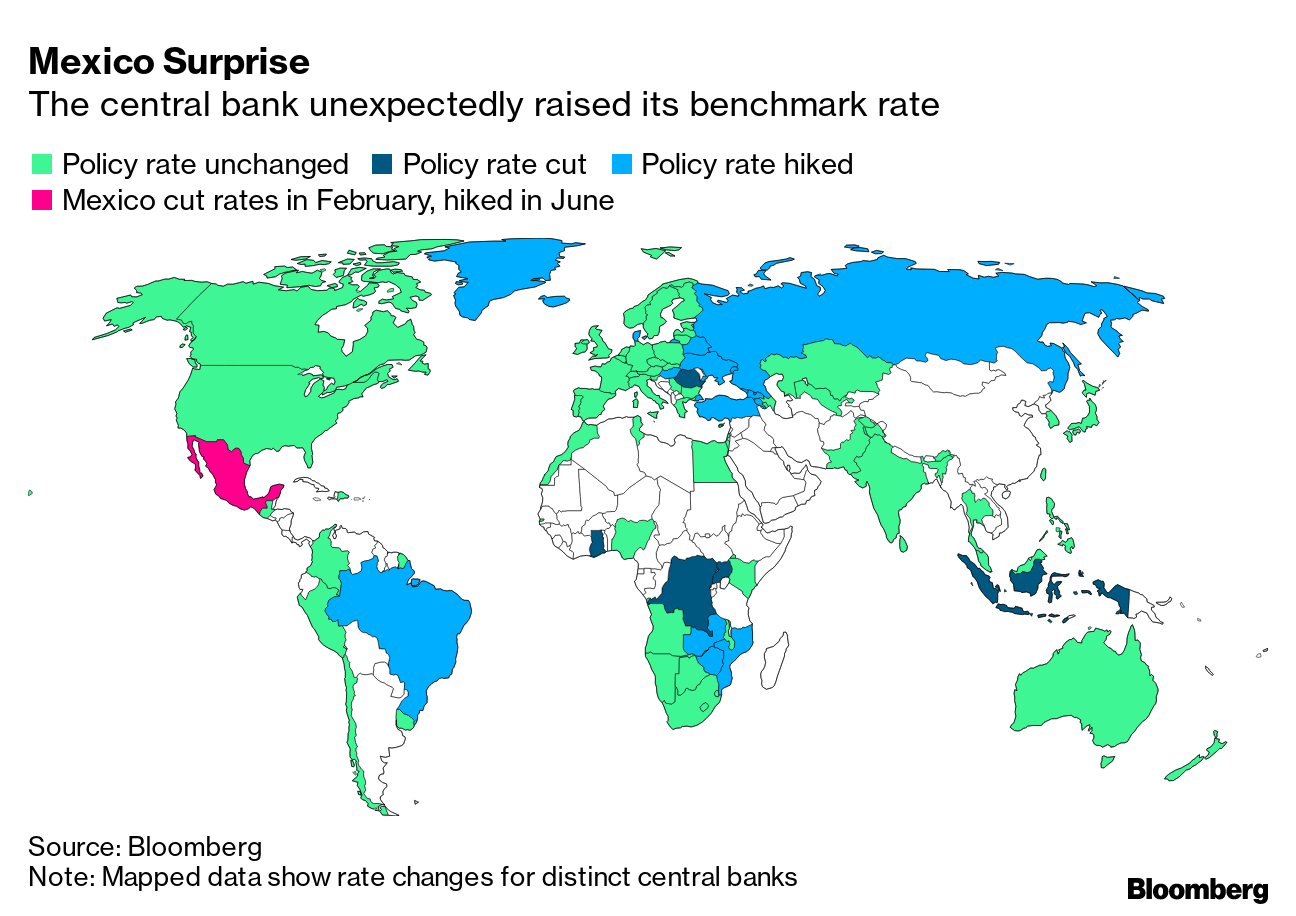 Mexico joined the hawkish band of Latin American central banks by unexpectedly raising interest rates.


https://platform.twitter.com/widgets.js twitter.com/robinwigg/status/1151195674979049472How markets have evolved over the past decade. pic.twitter.com/zrR5StdqzE— Robin Wigglesworth (@RobinWigg) July 16, 2019
TAC quantitative models show that the BRL is currently overvalued by about 25 to 30 per cent. The IMF index for the BRL real effective exchange rate suggests a 50 per cent overvaluation. With a combination of slower growth, higher external deficits, large speculative inflows and difficulty in cyclical management, the question is now not if the currency will depreciate, but when and by how much.


The world’s monetary system is in the process of melting down. We have entered the endgame for the dollar as the dominant reserve currency, but most investors and policy makers are unaware of the implications.
The only questions are how long the denouement of the dollar reserve system will last, and how much more damage will be inflicted by new rounds of quantitative easing or more radical monetary measures to prop up the system.
Whether prolonged or sudden, the transition to a stable monetary system will become possible only when the shortcomings of the status quo become unbearable. Such a transition is, by definition, nonlinear. So central-bank soothsaying based on the extrapolation of historical data and the repetition of conventional wisdom offers no guidance on what lies ahead.
It’s amazing that there is no intelligent discourse among policy leaders on the subject of monetary rot and its implications for the future economic and political landscape. Until there is fundamental monetary reform on an international scale, most economic forecasts aren’t worth the paper on which they are written.
Telltale signs of future trouble aren’t hard to spot. Only a few months ago, Federal Reserve Chairman Ben Bernanke and a chorus of other high-ranking Fed officials were talking about exit strategies from the U.S. central bank’s bloated balance sheet and the financial system’s unprecedented excess liquidity. Now, those same officials are talking about pumping more money into the system to stimulate growth.
Risky Targets
And they’re not alone: Six months ago, the chief economist of the International Monetary Fund, Olivier Blanchard, suggested that raising inflation targets to 4 percent from 2 percent wouldn’t be too risky.
This sort of talk must grate on the nerves of our trading partners, China, India, Russia and others, who have accumulated pyramids of non-yielding Treasury debt. No haven there. Return- free risk may be a better way to put it. And bickering among central bankers over currency manipulation and rising trade tensions doesn’t exactly reinforce one’s confidence in a scenario of sustained economic growth and a return to prosperity.
The prospects for an orderly unwinding of the extreme posture of global monetary policy are zero. Bernanke, Jean- Claude Trichet and Mervyn King, his counterparts in Europe and the U.K. respectively, are huddling en masse upon the most precarious perch in the history of monetary affairs. These alleged guardians of monetary stability, in their attempts to shore up the system, have simply created the incinerator for paper money. We are past the point of no return. Quantitative easing may well become a way of life.
No Freak Occurrence
The consensus investment view seems to be that the credit crisis of 2008 was a freak occurrence, unlikely to repeat. That is wishful thinking. Monetary policy has painted itself into a corner. Based on our present course, there will be more bubbles and more meltdowns.
Financial markets and institutions sense trouble, as reflected in the flight to supposedly safe assets such as Treasuries and corporate-debt instruments with paltry yields, as well as the reluctance to lend by commercial banks. We are stuck in an epic liquidity trap. The irony is, if global central banks succeed in creating inflation, the value of these safe assets will be destroyed. It is a slaughter waiting to happen.
In the pedantic mentality of central bankers, their playbook creates just the right amount of inflation. As inflation accelerates, consumers will spend to get rid of their dollars of diminishing value and spur the economy. Once consumers start spending, it will be time to raise interest rates because a solid foundation for prosperity will have been established, they say.
Slender Thread
But whatever the playbook promises, the capacity of financial markets to overshoot can’t be overestimated. The belief among policy makers and financial markets in the possibility of this sort of fine-tuning is preposterous, but it is the slender thread on which remaining investment and business confidence rests.
The breakdown of the monetary system will be chaotic. When inflation commences, it will be highly disruptive. The damage to fixed-income assets will seem instantaneous. Foreign-exchange markets will become dysfunctional. The economy will become even more fragile and unpredictable.
Gold is an imperfect, but comparatively reliable, market gauge for the extent of current and future monetary destruction. The recent acceleration in the dollar price of the metal to $1,381, a record high in nominal terms, coincided with talk of a new round of quantitative easing and highly visible discord among major nations on trade and currency-valuation issues.
Naysayers’ Bubble
Naysayers point to gold’s price and see a bubble, without understanding that the only acceleration that is taking place is in the rate of decline of paper currency. The Fed is organizing an attack on the dollar’s value, believing that this is the most expedient way to defuse deflationary market forces. The man in the street is unaware, a perfect setup. Inflation can only be successful when the public doesn’t see it coming.
The sudden torrent of commentary on gold isn’t the sign of a bubble. Anti-gold pundits provide a great service to those who grasp this historical moment: They facilitate the advantageous positioning of the one asset most likely to be left standing when the dust settles.
(John Hathaway is a managing director of Tocqueville Asset Management LP in New York. The opinions expressed are his own.)
To contact the writer of this column: John Hathaway at JHathaway@Tocqueville.com
To contact the editor responsible for this column: James Greiff at jgreiff@bloomberg.net
By Ellen Kelleher
Published: October 29 2010 18:30 | Last updated: October 29 2010 18:30
The focus of investors scouting about for value in the precious metals market has shifted to palladium, platinum and silver, as gold now trades at record levels.
Investment flows into exchange-traded funds (ETFs) backed by platinum and palladium have about matched or exceeded those wending their way into gold-backed ETFs in the last month, data from ETF Securities shows.
The rise in the metals’ prices is just as impressive. The cost of palladium – used as a catalyst in converters that clean car exhausts – soared 93 per cent to $626 a troy ounce in the past year, hitting a nine-year high thanks to a pick-up in interest from hedge funds. Silver – the poor man’s gold – now costs $23.73 per troy ounce, having risen more than 45 per cent in the same period. And platinum – palladium’s sister metal and a requisite component in diesel car engines – trades at more than $1,680 a troy ounce.
“Much like gold and platinum, palladium has experienced a QE2 sugar rush, not looking back since its $459.25 low of August 12 after the Fed decided to hold its balance-sheet constant,” said Edel Tully, a UBS commodities strategist.
The uptick in interest in the metals stems from the uncertainty surrounding the economy as well as fears about another round of quantitative easing in the US, and concerns about currency depreciation.
But volatility remains a concern. Starting next week, precious metal prices are likely to see sharp swings because of expected announcements from the Bank of England and the Federal Reserve, analysts forecast.
“Between now and the Federal Open Market Committee day, precious metals will likely endure patience-testing and see-saw price action,” wrote Tully in a recent note.
But even if prices swing in the near-term, longer-term forecasts for palladium in particular and platinum as well look compelling.
“Of all the precious metals, we’re most bullish on palladium,” claims Walter De Wet, head of commodities research at Standard Bank in London. “Demand is also strong for platinum but not as strong as it is for palladium.”
Demand for palladium is set to continue to exceed supply in the coming years as ownership of petrol-based cars becomes commonplace in China and other emerging market countries.
At the same time, palladium’s supply looks constrained. Some analysts speculate that the Russian government’s stockpiles of palladium may have dried up. Sales from the Russian government have added about 1m ounces of palladium supply annually in recent years.
UBS’s Tully forecasts that a shortage of supply from Russia could push palladium prices above $1,000 per troy ounce. Platinum prices, meanwhile, which have been rising since late 2008, look more toppy by comparison. Analysts argue that they have been pushed higher by speculators and the flow of money into emerging markets, which tends to boost commodities demand. While some expect platinum – the only metal that can be used as a catalytic converter in diesel engines – to rise higher yet in 2011, they think a correction is likely one day given that the metal has fewer industrial uses than palladium and is more costly.
“We believe that platinum positioning is over-extended; particularly as no ‘new’ fundamental driver has emerged,” says a recent UBS commodities research report.
Prospects for silver, meanwhile, are even less clear. While the metal still trades at record levels, commodities experts claim that it tends to move in line with the gold price. They warn that history suggests silver underperforms gold when markets fall and outperforms it when they rise. “The silver market surplus is quite bloated at the moment,” points out Suki Cooper of Barclays Capital. “If investment demand slows down for silver, we’re likely to see a sharp correction.”
But “silver fever” is still all the rage, with sales of silver coins set to hit a record high this year. Standard Bank’s De Wet concludes that gold and silver prices – which continue to benefit from strong interest from Asia – will see support through the Chinese new year which begins in February.
Copyright The Financial Times Limited 2010. Print a single copy of this article for personal use. Contact us if you wish to print more to distribute to others.
"FT" and "Financial Times" are trademarks of the Financial Times. Privacy policy | Terms
© Copyright The Financial Times Ltd 2010.
http://www.ft.com/cms/s/2/18ef998a-e382-11df-8ad3-00144feabdc0.html
Until we face up to the reality of the economic landscape before us, we will be on the same path as Japan, 1987-present...
The current situation reminds me of mid 2007. Investors then were content to stick their heads into very deep sand and ignore the fact that The Great Unwind had clearly begun. But in August and September 2007, even though the wheels were clearly falling off the global economy, the S&P still managed to rally 15%! The recent reaction to data suggests the market is in a similar deluded state of mind. Yet again, equity investors refuse to accept they are now locked in a Vulcan death grip and are about to fall unconscious. The notion that the equity market predicts anything has always struck me as ludicrous. In the 25 years I have been following the markets it seems clear to me that the equity market reacts to events rather than pre-empting them. We know from the Japanese Ice Age and indeed from the US 1930's experience, that in a post-bubble world the equity market merely follows the economic cycle. So to steal a march on the market, one should follow the leading indicators closely. These are variously pointing either to a hard landing or, at best, a decisive slowdown. In my view we are poised to slide back into another global recession: the data is slowing sharply but, just like Japan in its Ice Age, most still touchingly believe we are soft-landing. But before driving off a cliff to a hard (crash?) landing we might feel reassured when we pass a sign that reads Soft Landingand we can kid ourselves all is well. I read an interesting article recently noting the equity market typically does not begin to slump until just AFTER analysts begin to cut their 12m forward EPS estimates (for the life of me I can't remember where I read this, otherwise I would reference it). We have not quite reached this point. But with margins so high, any cyclical slowdown will crush productivity growth. Already in Q2, US productivity growth fell 1.8% - the steepest fall since Q3 2006.Hence, inevitably, unit labour costs have begun to rise QoQ. This trend will be exacerbated by recent more buoyant average hourly earnings seen in the last employment report. Whole economy profits are set for a 2007-like squeeze. And a sharp slide in analysts' optimism confirms we are right on the cusp of falling forward earnings (see chart below).  I love the delusion of the markets at this point in the cycle. It bemuses me why investors cannot see what is clear as the rather large nose on my face. Last Friday saw the equity market rally as August's 67k rise in private payrolls and an upwardly revised July rise of 107kbeat expectations. But did I miss something? When did we switch from looking at headline payrolls to private jobs? Does the fact that government is shedding jobs not matter? Admittedly temporary census workers do mess up the data, but hey, why not look at nonfarm payroll data ex census? Why not indeed? Because the last 4 months run of data looks notably weaker on payrolls ex census basis than looking only at the private payroll data (ie Aug 60k vs 67k, July 89k vs 107k, June 50k vs 61k and May 21k vs 51k). But these data, on either definition, look dreadful compared to the 265k rise in April and 160k in March (ex census definition). If someone as pathologically lazy as me can find the relevant BLS webpage after a quick call to the BLS (link), why can't the market? Because it is bad news, that's why.  August's rebound in the US manufacturing ISM was an even bigger surprise. This is a truly nonsensical piece of datum as it was totally at variance with the regional ISMs that come out in the weeks before. The ISM is made up of leading, coincident and lagging indicators. The leading indicators - new orders, unfilled orders and vender deliveries - all fell and point to further severe weakness in the headline measure ahead (see chart above). It was the coincident and lagging indicators such as production, inventories and employment that drove up the headline number. Some of the regional subcomponents (eg Philadelphia Fed workweek) are SCREAMING that recession is imminent (see left hand chart below).   The real reason why markets reversed last week was that they got ahead of themselves. Aside from the end of 2008, government bonds were the most over-bought they had been over the last decade. And in equity-land the AAII two weeks ago recorded a historically low 20% of respondents as bullish (see chart above). These technical extremes will now be quickly worked off before the plunge in equity prices and bond yields resumes. I am often asked by investors with a similar view of the world to my own (yes, there are some),whether the equity market will ever reach my 450 S&P target because of the likelihood that further Quantitative Easing will prevent asset prices from falling back to cheap levels. Indeed we know that a central plank of the unhinged policies being pursued by the Fed and other central banks is to use QE to deliberately target higher asset prices. Ben Bernanke in a recent Jackson Hole speech dressed this up as a "portfolio balance channel", but in reality we know from current and previous Fed Governors (most notably Alan Greenspan), that they view boosting equity and property prices as essential for boosting economic activity. Same old Fed with the same old ruinous policies. And by keeping equity and property prices higher, the US and UK Central Banks are still trying to cover up their contribution towards the ruination of American and British middle classes - (see GSW 21 January 2010, Theft! Were the US and UK central banks complicit in robbing the middle classes? - link). The Fed may indeed prevent equity prices from slumping with any QE2 announcement. But this sounds a familiar refrain at this point in the cycle. For is monetary easing in the form of QE that different from interest rate cuts in its ability to boost equity prices? Indeed announced rate cuts in previous downturns often did generate decent technical rallies. But in the absence of any imminent cyclical recovery, equity prices continue to slide lower (see chart below). The key for me is whether QE2 can revive the economic cycle, not equity prices temporarily.  In the absence of a cyclical recovery I cannot see how QE is any different in its ability to revive asset prices than lower rates in anything other than a temporary fashion. (Interestingly many of our clients think QE2 might give a temporary fillip to the risk assets but that the subsequent failure to produce any cyclical impact will cause an extremely violent reaction as investors lose faith in QE as a policy tool and Central Banks in general.) If we plunge back into recession, do not place too much confidence in the Central Banks having control of events. As my colleague, Dylan Grice, said last week "let them keep pressing their buttons." Ultimately they cannot fool all of the investors, all of the time. |


 Posts
All Comments
Posts
All Comments


