MasterFeeds: default

Subscribe in a reader Add to Google Reader or Homepage

Showing posts with label default. Show all posts

Sep 21, 2021

#Caixin Goes All-In on #EverGrande’s Potential Fallout & Contagion

Cover Story: How Evergrande Could Turn Into 'China's Lehman Brothers' - Caixin Global


Evergrande has more than 800 billion yuan ($124 billion) due within one year—but it has only a 10th of that amount of cash on hand.

@UBS estimates $19 billion of Evergrande's liabilities are made up of outstanding offshore bonds. A potential default could spread to markets outside China as it has huge, high-interest offshore bonds— some with rates as high as 15%. 

Here are some basic numbers on Evergrande to give you an idea why many consider it to be #TBTF—Too Big To Fail.

  • Current liabilities equivalent to ±2% of China's GDP. 
  • It has more than 200,000 employees, who themselves and many of their families have invested billions of yuan in the company's WMPs. 
  • More than 800 projects under construction, more than half of them halted due to its cash crunch. 
  • Thousands of upstream & downstream companies rely on Evergrande for business, creating more than 3.8 million jobs every year

Here's Caixin’s take on the current situation. 

How Evergrande Could Turn Into 'China's Lehman Brothers'

For the past two months, hundreds of people have been gathering at the 43-floor Zhuoyue Houhai Center in Shenzhen, where China Evergrande Group's headquarters occupy 20 floors. They held banners demanding repayment of overdue loans and financial products. Police with riot shields had to be on site to keep things under control.

The demonstrators are construction workers at the property developer's housing projects, suppliers providing construction materials and investors in the company's wealth management products (WMPs).

Jan 7, 2020

Are We Finally Looking At #Lebanon’s #debt #default?


Thinking the unthinkable: Lebanon's sovereign debt default?
Matein Khalid
January 02, 2020

The unthinkable has finally happened in a secretive central bank's digital ledger in the heart of Beirut. The rating agency Fitch predicts imminent default on Lebanon's sovereign debt, at $88bn, a colossal 185% of GDP, making the once "Paris of the Middle East, the fabled reve d'Orient (dream of the East) a Levantine Argentina. While central bank data often lies in the emerging markets, Fitch's arithmetic of doom is irrefutable. Fitch estimates that the Banque du Liban, run by an ex-Merrill Lynch broker Riad Salameh as governor since 1993, owes $67 billion dollars to Lebanese banks in borrowings (liabilities) but has only $28 billion in net foreign exchange reserves.

Salameh's high stakes juggling act of borrowing money at exorbitant rates from Lebanese banks, flush with funds from a diaspora that extends from the Swiss Alps to São Paulo, from the diamond mines of West Africa to the glass towers of Dubai's DIFC Gate Village, to meet the state's $5 billion annual debt service obligations, maintain the Lebanese pound currency peg to King dollar, finance imports for a population whose elite defines la dolce vita on the East Med and bankroll a bloated, warlord/sectarian fissured public finance payroll, is now over.

Optically, Lebanon boasts $150 billion in banking deposits, three times its GDP, a ratio exceeded only by the banking systems of Hong Kong and Luxembourg. Yet this banking data is a cruel illusion, a hoax perpetuated on the hapless savers of Lebanon and its vast global diaspora. Lebanese banks have recklessly invested 50% of their assets in Lebanese government's Treasury bills, de facto post dated cheques/IOU's on a bankrupt bank. 

Where did these untold billions in debt vanish? 

Jun 18, 2016

The Debt Market Is Flashing Danger Right Now

You may not realize how much bigger this problem has become in just the past few months…
These are the charts you need to see:


See the post on Casey Research here: 
https://www.caseyresearch.com/articles/the-debt-market-is-flashing-danger-right-now#.V2UT6LatesE.blogger

Jun 19, 2015

Sudden Plunge in #Venezuela Reserves Alarms Creditors @Business

BofA estimated Venezuela had $77bn of assets available for sale or securitization at the end of the first quarter, down from $81 billion in 2014.

Venezuela’s reserves are dwindling after the price of oil, which accounts for 95 percent of the nation’s export revenue, fell 44 percent in the past year. Traders now see a 44 percent chance the country will default in the next year, the highest in the world and up from 34 percent a month ago.

Facing an ever-worsening shortage of hard currency, President Nicolas Maduro has pulled an average of $65 million a day from central bank reserves since the end of March.

Read the whole article online on Bloomberg here:  The Sudden Plunge in Venezuela Dollar Reserves Alarms Creditors - Bloomberg Business

Share
-- The MasterFeeds

Oct 3, 2011

NY Fed May Demand Reports From Europe Banks - Bloomberg

NY Fed May Demand Reports From Europe Banks

By Meera Louis - Oct 2, 2011

The Federal Reserve Bank of New York may ask foreign lenders for more detailed daily reports on liquidity as the U.S. steps up monitoring of risks from Europe's sovereign debt crisis, according to two people with knowledge of the matter.

Regulators held informal talks with some of the largest European lenders about producing a "fourth-generation daily liquidity" or 4G report, according to the people, who asked for anonymity because communications with central bankers are confidential. The reports may cover potential liabilities such as foreign-exchange swaps and credit-default swaps, said one person. The U.S. has already increased the number of examiners embedded in these banks, the person said.

Concern is growing that European lenders may falter as Greece teeters on the brink of default. U.S. Treasury Secretary Timothy F. Geithnerhas warned that failure to bolster European backstops would threaten "cascading default, bank runs and catastrophic risk" for the global economy.

"The Fed is trying to understand what the pressure points are in terms of liquidity and potential risks that are imposed by foreign banks to domestic institutions in our financial system," said Kevin Petrasic, an attorney at the Washington- based law firm of Paul, Hastings, Janofsky & Walker LLC. "There is a little bit more sense of urgency as a result of what's going on in Europe."
Liquidity Risk

U.S.-based money funds, which buy short-term commercial paper, have been shunning securities issued by some banks based on the continent, and European Central Bank Governing Council member Yves Mersch said Sept. 28 that liquidity shortages pose the main risks to the region's banking system.

Jack Gutt, a spokesman for the Federal Reserve Bank of New York, declined to comment. The largest European bank holding companies by assets in the U.S. include units of Deutsche Bank AG (DBK), HSBC Holdings Plc. (HSBA) and Banco Bilbao Vizcaya Argentaria S.A., according to Fed data. Duncan King, a spokesman for Frankfurt- based Deutsche Bank, Thaddeus Herrick, a spokesman for Spain- based BBVA and London-based HSBC's Rob Sherman said they couldn't comment.

U.S. banks are starting to provide a 4G report and they are being phased in this month, said Karen Shaw Petrou, managing partner of Washington-based Federal Financial Analytics Inc. Some Europeans are asking U.S. counterparts for information on how to prepare the report even though there has been no formal request from the Fed so far, one of the people said.
Avoiding a Squeeze

"The report requires rapid and in some cases daily data on a banks' assets, liabilities and potential claims to measure the degree to which the bank could be caught in the classic borrow- short, lend-long squeeze," Petrou said. "The 4G is one of the tools to reveal liquidity risk."

The forms aren't public, according to Petrou, and the New York Fed declined to provide a copy.

Euro-zone banks and other institutions were more than $350 billion in debt to the Fed's emergency-lending facilities at one point during the2008-2009 financial crisis, according to data compiled by Bloomberg News. The analysis was based on Fed documents released earlier this year after court orders upheld Freedom of Information Act requests by Bloomberg LP, the parent company of Bloomberg News, and News Corp.'s Fox News Network LLC. Fed lending to these entities totaled more than $100 billion on an average day.
Swap Contracts

Regulators lack access to data on foreign institutions operating in the U.S. that would allow them to "make informed judgments about the adequacy of such firms' capital and liquidity buffers," William C. Dudley, president of the Federal Reserve Bank of New York, said in a Sept. 23 Washington speech.

U.S. prime money-market funds cut their exposure to euro- zone bank deposits and commercial paper, or short-term IOUs, to $214 billion in August from $391 billion at the end of last year, according to JPMorgan Chase & Co. data. The funds are rationing their credit to European banks because of concerns that financial institutions will take large losses if a euro- zone nation defaults.

Credit-default swaps allow bondholders to buy protection against losses if an issuer doesn't pay its debts. The contracts can entitle the holder to face value if the borrower defaults. Lawmakers and regulators have blamed misuse of swaps and lack of disclosure for helping to trigger the 2008 financial crisis.

A currency swap is a contract in which one party borrows one currency from another, and simultaneously lends another to the second party. Foreign-exchange swaps are used to raise foreign currencies for financial institutions and their customers, such as exporters and importers as well as investors.

Currencies and their related derivatives are among the most actively traded markets in the world, with average daily turnover reaching $4 trillion as of September 2010, Bank for International Settlements estimates.

To contact the reporter on this story: Meera Louis in Washington at mlouis1@bloomberg.net

To contact the editors responsible for this story: Lawrence Roberts at lroberts13@bloomberg.net; Rick Green at rgreen18@bloomberg.net

http://www.bloomberg.com/news/2011-10-02/new-york-fed-may-demand-europe-s-banks-produce-more-details-on-liquidity.html

Aug 6, 2011

S&P cuts US debt rating to double A plus

It was a long time coming, well it's finally here:
S&P cuts US debt rating to double A plus
FT
--
By Robin Harding in Washington and Aline van Duyn and Telis Demos in New York
--
Contentious and historic move highlights the weakened fiscal stature of the world's most powerful country
Read the full article at: http://on.ft.com/r09VBs
Sent from my iPad

Jul 27, 2011

Moody’s downgrades Cyprus bonds

Another one "to bite the dust?"

Moody's decision to lower Cyprus' debt rating to just above junk status is the latest sign the island nation may become the fourth eurozone country heading towards a bail-out


Moody's downgrades Cyprus bonds
--
By Peter Spiegel in Brussels
--
The rating agency's decision is the latest sign the island nation may become the fourth eurozone country heading towards a bail-out

Read the full article at: http://on.ft.com/r3wlk1


Sent from my iPad

Jul 20, 2011

China complains of U.S. debt, but has too much at stake to dump dollars

It is the ultimate ''too big to fail'' global relationship, said Andy Rothman, an analyst in Shanghai for the investment bank CLSA. If Beijing even hinted that it might try to sell part of its U.S. debt, ''other countries might sell their dollar assets,'' Mr. Rothman said, noting that this would drive down the value of China's holdings. ''It would be financial suicide for China.''


From The International Herald Tribune:

China complains of U.S. debt, but has too much at stake to dump dollars
BY DAVID BARBOZA

SHANGHAI — However grim Washington's debt and deficit negotiations may seem to U.S. citizens, the impasse is nearly as disturbing for China.

As the United States' biggest foreign creditor — holding an estimated $1.5 trillion in Treasury securities and other U.S. government debt — China has been a vocal critic of what it considers Washington's politicized profligacy.

''We hope that the U.S. government adopts responsible policies and measures to guarantee the interests of investors,'' Hong Lei, a Foreign Ministry spokesman, said at a news conference last week.

Beijing might prefer to respond by starting to dump some of its U.S. debt. But in this financial version of the Cold War, analysts say, both sides fear mutually assured destruction. One reason America would want to avoid defaulting on its debt is that such a move could alienate China, which is a steady purchaser of Treasury securities. Beijing, meanwhile, already has too much invested in U.S. debt to do much more but continue to buy, hold and grumble.

It is the ultimate ''too big to fail'' global relationship, said Andy Rothman, an analyst in Shanghai for the investment bank CLSA. If Beijing even hinted that it might try to sell part of its U.S. debt, ''other countries might sell their dollar assets,'' Mr. Rothman said, noting that this would drive down the value of China's holdings. ''It would be financial suicide for China.''


http://www.nytimes.com/2011/07/19/business/china-largest-holder-of-us-debt-remains-tied-to-treasuries.html

Get the best global news and analysis direct to your device – download the IHT apps for free today!
For iPad: http://itunes.apple.com/us/app/international-herald-tribune/id404757420?mt=8
For iPhone: http://itunes.apple.com/us/app/international-herald-tribune/id404764212?mt=8


Sent from my iPad

Mar 7, 2011

John Paulson's Interview With The Financial Crisis Inquiry Commission

John Paulson's Interview With The Financial Crisis Inquiry Commission
Courtesy of zerohedge.com
Description: http://feedads.g.doubleclick.net/~a/PXYKT80O_G58AtnxN_TohOTCkN8/1/di
John Paulson, of the eponymous uber-hedge fund did an hour-long interview with the Financial Crisis Inquiry Commission.  I listened to it (thanks to NYT Dealbook, although not sure where they got it from), and really, I got a kick out of it even though I think my carpal-tunnel is really flaring up now.  Anyway, without further ado, here's what the man behind the Greatest Trade Ever has to say about the Financial Crisis…
Description: http://stonestreetadvisors.wordpress.com/wp-includes/js/tinymce/plugins/wordpress/img/trans.gifWhen asked what he saw, when, and why he decided to get short, he said "First thing we noticed was that real estate market appeared very frothy, values rose very rapidly, which led me to believe real estate markets were over valued."  That's pretty simple/straightforward, no?  I think it's pretty interesting that he said the 3 homes he's bought were all out of foreclosure, and they'd increased in value 4-5x over a 2-3 year period through ~'2005.  Apparently the impetus for the research that led to The Trade was literally staring him in the face every time he got home from work!
He explained his approach, and the way he put it makes me really think the guys who didn't leave their trading desks & "never saw the bubble/crash coming" really had their heads buried in the sand deeper than I previously thought.  As Paulson said, "Credit markets were very frothy, very little attention paid to risk, spreads were very low, we thought when those securities correct, it could present opportunities on short side."
Their research approach was pretty straight-forward: Focus on subprime, where they were amazed at how low quality the underwriting was, and how low the credit characteristics were on the loans.  They found the average FICO  was around 630, and over half of the loans were for cash-out refi's, which were based on appraised, not sales prices (so "value" could be manipulated).  For many of these loans, LTV was very, very high, 80, 90, 100% with many of them concentrated in California (no surprise there).  Close to have of the mortgages they looked at were of the stated-income, no-doc variety.
Those who did report incomes had D/I ratios of > 40% before taxes and insurance.  80% of them were ARMs, so-called 2/28's with teaser rates around 6-7% for those first 2 years, but after they reset, the rates were L+ 600bps which at the point would have doubled the interest rate on these loans, and Paulson & Co thought there was very little - if any - chance borrowers would be able to afford the higher payments.
Once the rates reset, the only thing these borrowers could do would be to sell, refinance, or default.  These were people spending > 40% of their gross income on their mortgages already, once the rate jumped up after the teaser period, they expected that many borrowers would simply default, and the price of the RMBS into which these loans were securitized would fall drastically, while the price of the protection (CDS, etc) Paulson bought on them would skyrocket.
Paulson & co also went much further in their analysis, well-beyond what many of those on Wall Street were doing.  In May, 2006, they researched growth of 100 MSA's and found that there was a correlation between growth and the performance of subprime loans originated within them.  As growth rates slowed, defaults rose.  From 2000-2005, they found that with 0% growth, there'd be losses of around 7% in the mortgage pools.
When they looked at the structure of the RMBS they found the average securitization had 18 separate tranches and that the BBB level only had 5.6% subordination, essentially, once losses surpassed that point, the tranches would become impaired, and if they reached 7% losses (what Paulson thought would happen once home price appreciation only slowed to 0%), the entire tranch would get wiped-out entirely.
By mid-2006, home prices not only had slowed to 0% but were actually decreasing, albeit slowly, only about 1%.  Even still, demand from institutional investors was so great, spreads tightened to 100bps. Why?  Because as Paulson went on to explain, institutional investors were buying up the BBB tranches (the lowest investment grade ones) in hoards.
While he didn't say it, I will (for the umpteenth time!): This is what happens when institutions effectively outsource credit research to the Ratings Agencies, even though many had/have internal credit analysis groups (ahem IKB ahem).  They buy the highest-yielding security you can find that meets your investment guidelines, which meant that for many, they could only buy securities deemed by the brain trusts at the Ratings Agencies as "Investment Grade."
Paulson started their credit fund in June, 2006, and as he explained, it wasn't really as simple as it may seem. Historically - going back to about WWII - the average loss on subprime securities was 60bps, nowhere near what Paulson & Co expected was about to happen.  As he said "according to the mortgage people, there'd never been a default on an investment grade (IG) mortgage security."  These same people were also of the mindset that they'll NEVER get to the levels where the BBB tranches are impaired let alone wiped out completely.   These were also the same people who said that not since the Great Depression there hadn't been a single period where home prices declined nation-wide.  These same people thought, worst case, home price growth would drop to 0% temporarily and then return to growth, just like before.

Dec 16, 2010

Debt Factoids on Our National Debt Are Puzzling - And Scary - Seeking Alpha

If you’re interested in the subject of our national debt, there is a new must read report from the Congressional Budget Office (CBO) on the topic. It includes some odds and ends that I found interesting.
We know that there is a law called the debt ceiling. We also know that we will (again) hit that limit early in 2011. Many think that this will be a line in the sand fight with the new Congress. Phooey. According to the CBO report, suspending issuance of maturing cash management bills in the supplementary financing program will cost $200 billion; suspending flows and redeeming securities in government accounts, $124 billion; from the civil service retirement fund, "at least" $200 billion; from the exchange stabilization fund, $20 billion; and swapping debt with the federal financing bank, $15 billion. Total: $560 billion.
Conclusion: If there is to be a fight over the debt limit, it could be a long one.
The CBO is speaking with forked tongue in this report. A critical issue: How do we define what debt is at the federal level?
There are so many components to the puzzle. I give the CBO an A+ for this position:
CBO believes it is appropriate and useful to policymakers to include Fannie Mae’s and Freddie Mac’s financial transactions with other federal activities in the budget. The two entities do not represent a net asset to the government but a net liability — that is, their impact on the government’s financial position is a negative one.
So how does CBO actually account for F/F? It gets a D- for this:
Neither CBO nor the Administration currently incorporates debt or MBSs issued by Fannie Mae (FNMA.OB) and Freddie Mac (FMCC.OB).
That’s interesting. They say they “should” do it, but they don’t. Who makes that decision?
The Administration’s Office of Management and Budget (OMB) makes the ultimate decision about whether the activities of Fannie Mae and Freddie Mac will be included in the federal budget.
The White House decides which categories of debt are included when determining what constitutes debt? That is convenient. When did that happen? We are not talking chicken scratch here. The good folks over at the Fannie and Freddie have piled up $6 trillion in debt. We would blow out the debt ceiling set by Congress by over 40% if that came on the books. So it stays off the books. But the debt is staring us in the face. Funny system.
This also caught my eye:
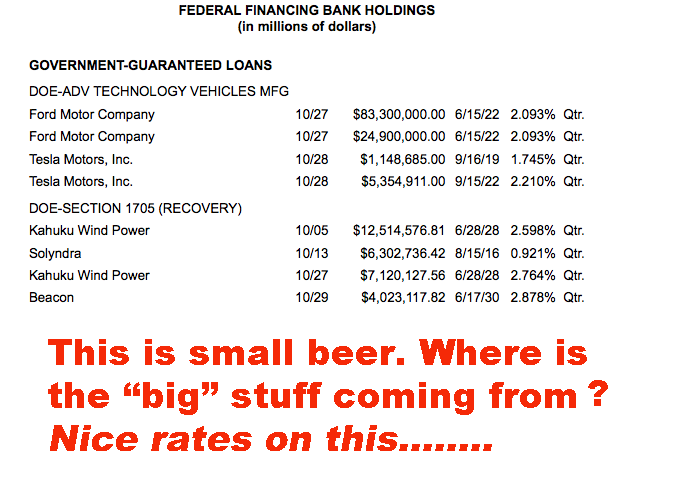
Payments of interest from the FFB to the Treasury have been less than $1 billion annually in recent years but are projected to increase (to as much as $6 billion) because of higher loan activity (particularly by the Department of Energy's Advanced Technology Vehicles Manufacturing program and the Rural Utilities Service). As of September 30, 2010, the FFB portfolio totaled $60 billion.
Hello, what is this? For interest to rise at the FFB from $1 billion to $6 billion, it would have to imply that there is at least a four- or five-fold increase in the balance sheet. This means that there is a plan to grow the FFB by $250 billion. Who is going to be the beneficiary of that? That is a hell of a lot of money. Is the FFB going to fund a solar build-out? The existing portfolio of Department of Energy loans:
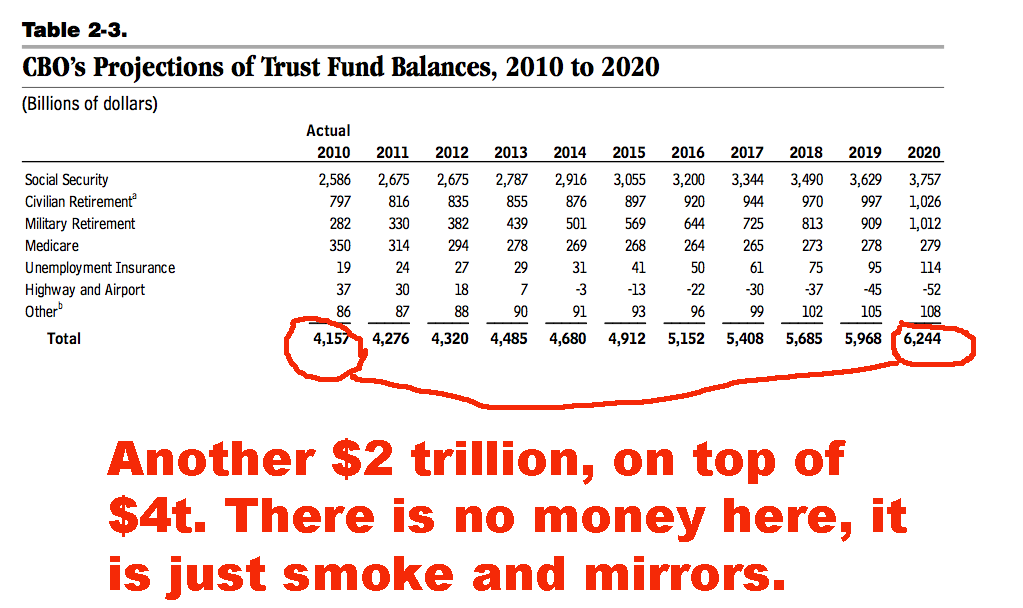
Another (minor) data point of interest: The federal government has a number of trust funds that are used as accounting vehicles to store up IOUs from the government. The principal accounts and current holdings:
Social Security Trust Fund…….2.6t
Civil Service Retirement Fund...0.8t
Military Retirement Fund……...0.3t
Medicare……………………….0.3t
All others…….………………...0.6t

Total:…………………………..4.6 trillion
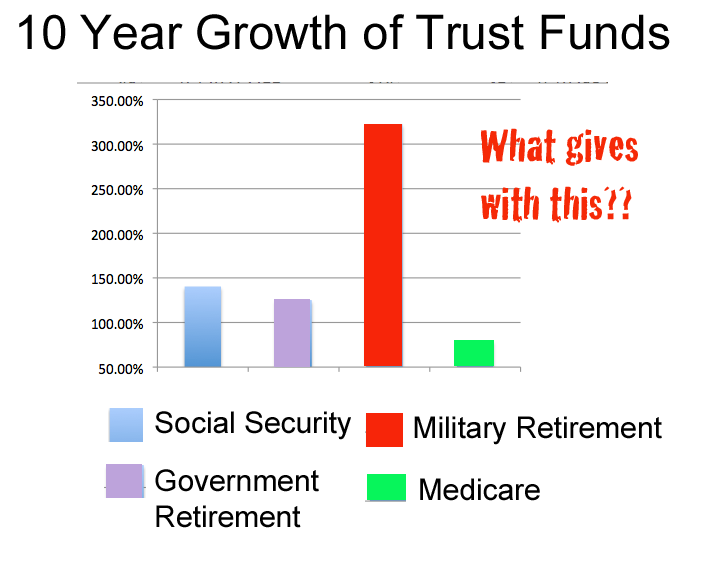
These funds are all anticipated to grow over the next decade. One has a growth rate that is way out of whack with the others:
The Military Retirement Fund is growing at three times the rate of the others. The raw numbers are $282 billion for 2010 and $1.012 trillion for 2020. That's a 10-year increase of $730 billion (a 350% increase). What is that about? Are we planning on a new war, or have we just not accounted for the retirement costs of the military properly over the past decade or two? I suspect (hope) it is the latter.
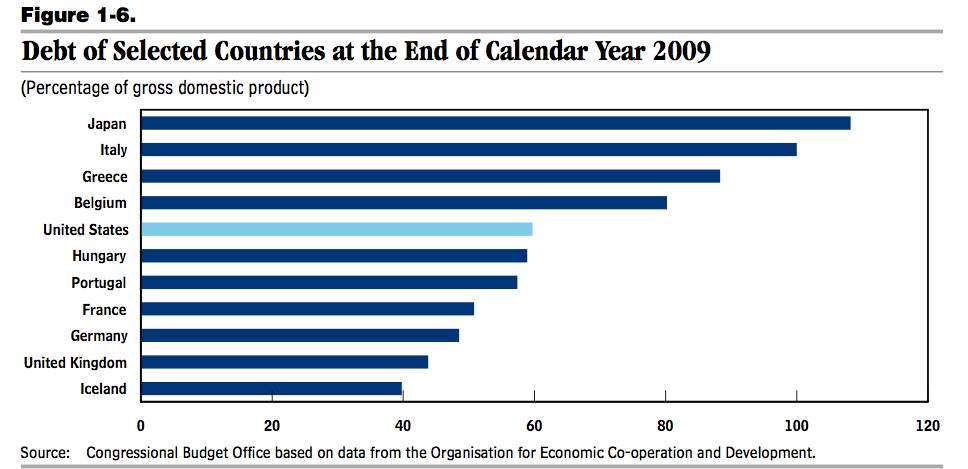
We have all seen a form of this chart elsewhere. It is nothing to be proud of. Yes, there are a few countries in worse shape than us. But Italy, Greece and Belgium are now making front-page news with their debt. And the U.S. will have a different outcome than Japan.
This chart of trust fund assets is central to our problem. Notice that these funds are scheduled to grow by more than $2 trillion. It sounds nice that the nation has trust funds where money is squirreled away someplace safe -- money that can be used to pay bills (Social Security) when they come due over the next 20 years.
But there is no money in the trust funds. They have IOUs that obligate future taxpayers to come up with the cash when needed. The trust funds have nothing to do with “savings” in the traditional sense.
This has been going on since 1983, when Greenspan created the accounting gimmick and the huge surpluses that followed. The fact is we do have future liabilities, and there have been some savings set aside for that. But the money has been spent on funding past deficits. So, really, there are no savings.
I am not sure there is a fix to this problem. I do know that the bills on this are coming due in the next five years or so. I don’t think we will make it another 10 years without having to confront this problem.


Debt Factoids on Our National Debt Are Puzzling - And Scary - Seeking Alpha

Dec 6, 2010

Bernanke on CBS’s ‘60 Minutes’ - Real Time Economics - WSJ

Need a Real Sponsor here

Bernanke on CBS’s ‘60 Minutes’

Federal Reserve Chairman Ben Bernanke appeared Sunday evening on CBS’s “60 Minutes” to discuss the state of the economy, the central bank’s controversial $600 billion bond-buying plan and the financial crisis. Following are excerpts from the interview with CBS’s Scott Pelley, as released by the network:
Q: The major banks are racking up profits in the billions. Wall Street bonuses are climbing back up to where they were. And yet, lending to small businesses actually declined in the third quarter. Why is that?

A: A lot of small businesses are not seeking credit, because, you know, because their business is not doing well, because the economy is slow. Others are not qualifying for credit, maybe because the value of their property has gone down. But some also can’t meet the terms and conditions that banks are setting.
Q: Is this a case of banks that were eager to take risks that ruin the economy being now unwilling to take risks to support the recovery?

A: We want them to take risks, but not excessive risks. we want to go for a happy medium. And I think banks are back in the business of lending. But they have not yet come back to the level of confidence that –or overconfidence –that they had prior to the crisis. We want to have an appropriate balance.
Q: What did you see that caused you to pull the trigger on the $600 billion, at this point?

A: It has to do with two aspects. the first is unemployment The other concern I should mention is that inflation is very, very low, which you think is a good thing and normally is a good thing. But we’re getting awfully close to the range where prices would actually start falling.
Q: Falling prices lead to falling wages. It lets the steam out of the economy. And you start spiraling downward. … How great a danger is that now?

A: I would say, at this point, because the Fed is acting, I would say the risk is pretty low. But if the Fed did not act, then given how much inflation has come down since the beginning of the recession, I think it would be a more serious concern.
Q: Some people think the $600 billion is a terrible idea.
A: Well. I know some people think that but what they are doing is they’re looking at some of the risks and uncertainties with doing this policy action but what I think they’re not doing is looking at the risk of not acting.
Q: Many people believe that could be highly inflationary. That it’s a dangerous thing to try

A: Well, this fear of inflation, I think is way overstated. we’ve looked at it very, very carefully. We’ve analyzed it every which way. One myth that’s out there is that what we’re doing is printing money. We’re not printing money. The amount of currency in circulation is not changing. The money supply is not changing in any significant way. What we’re doing is lowering interest rates by buying treasury securities. And by lowering interest rates, we hope to stimulate the economy to grow faster. So, the trick is to find the appropriate moment when to begin to unwind this policy. And that’s what we’re going to do.
Q: Is keeping inflation in check less of a priority for the Federal Reserve now?

A: No, absolutely not. What we’re trying to do is achieve a balance. We’ve been very, very clear that we will not allow inflation to rise above two percent or less.
Q: Can you act quickly enough to prevent inflation from getting out of control?

A: We could raise interest rates in 15 minutes if we have to. So, there really is no problem with raising rates, tightening monetary policy, slowing the economy, reducing inflation, at the appropriate time. Now, that time is not now.
Q: You have what degree of confidence in your ability to control this?

A: One hundred percent.
Q: Do you anticipate a scenario in which you would commit to more than 600 billion?

A: Oh, it’s certainly possible. And again, it depends on the efficacy of the program. It depends, on inflation. And finally it depends on how the economy looks.
Q: How would you rate the likelihood of dipping into recession again?

A: It doesn’t seem likely that we’ll have a double dip recession. And that’s because, among other things, some of the most cyclical parts of the economy, like housing, for example, are already very weak. And they can’t get much weaker. And so another decline is relatively unlikely. Now, that being said, I think a very high unemployment rate for a protracted period of time, which makes consumers, households less confident, more worried about the future, I think that’s the primary source of risk that we might have another slowdown in the economy.
Q: You seem to be saying that the recovery that we’re experiencing now is not self-sustaining.

A: It may not be. It’s very close to the border. — it takes about two and a half percent growth just to keep unemployment stable. And that’s about what we’re getting. We’re not very far from the level where the economy is not self-sustaining.
Q: [On calls to cut the deficit]

A: We need to play close attention to the fact that we are recovering now. We don’t want to take actions this year that will affect this year’s spending and this year’s taxes in a way that will hurt the recovery. That’s important. But that doesn’t stop us from thinking now about the long term structural budget deficit. We’re looking at ten, 15, 20 years from now, a situation where almost the entire federal budget will be spent on Medicare, Medicaid, Social Security, and interest on the debt. There won’t be any money left for the military or for any other services the government provides. We can only address those issues if we think about them now.
Q: How concerned are you about the calls that you’re beginning to hear on Capitol Hill that would curb the Fed’s independence?
A: Well, the Fed’s independence is critical. The central bank needs to be able to make policy without short term political concerns. In order to do what’s best for the economy. We do all of our analysis, we do all of our policy decisions based on what we think the economy needs. Not based on when the election is or what political conditions are.
Q: Is there anything that you wish you’d done differently over these last two and a half years or so?

A: Well, I wish I’d been omniscient and seen the crisis coming, the way you asked me about, I didn’t, But it was a very, very difficult situation. And– the Federal Reserve responded very aggressively, very proactively
Q: How did the Fed miss the looming financial crisis?
A: there were large portions of the financial system that were not adequately covered by the regulatory oversight. So, for example, AIG was not overseen by the Fed. … The insurance company that required the bailout, was not overseen by the Fed. It didn’t really have any real oversight at that time. Neither did Lehman Brothers the company that failed Now, I’m not saying the Fed should not have seen some of these things. One of things that I most regret is that we weren’t strong enough in in putting in consumer protections to try to cut down on the subprime lending problem. That was an area where I think we could have done more.
Q: The gap between rich and poor in this country has never been greater. In fact, we have the biggest income disparity gap of any industrialized country in the world. And I wonder where you think that’s taking America.

A: Well, it’s a very bad development. It’s creating two societies. And it’s based very much, I think, on– on educational differences The unemployment rate we’ve been talking about. If you’re a college graduate, unemployment is five percent. If you’re a high school graduate, it’s ten percent or more. It’s a very big difference. It leads to an unequal society and a society– which doesn’t have the cohesion that– that we’d like to see.
Q: We have talked about how the next several years are going be tough years in this country. But I wonder what you think about the ten year time horizon. Fifteen years. How do things look to you long term?

A: Long term, I have a lot of confidence in the United States. We have an excellent record in terms of innovation. We have great universities that are involved in technological change and progress. We have an entrepreneurial culture, much more than almost any other country. So, I think that in the longer term the United States will retain its leading position in the world. But again, we gotta get there. And we have some very difficult challenges over the next few years.
Copyright 2008 Dow Jones & Company, Inc. All Rights Reserved
This copy is for your personal, non-commercial use only. Distribution and use of this material are governed by our Subscriber Agreement and by copyright law. For non-personal use or to order multiple copies, please contact Dow Jones Reprints at 1-800-843-0008 or visit
www.djreprints.com


Bernanke on CBS’s ‘60 Minutes’ - Real Time Economics - WSJ

Share
-- The MasterFeeds

Oct 30, 2010

Gold Will Outlive Dollar Once Slaughter Comes: John Hathaway - Bloomberg

Gold Will Outlive Dollar Once Slaughter Comes: John Hathaway - Bloomberg

Share
________________________

Aug 14, 2010

Currencies The Race to the bottom

Currencies
Race to the bottom

A weak economy and an active Federal Reserve have driven the dollar down since June. Will that last?

THREE months ago, when Europe’s debt crisis had markets panicking about sovereign risk, it seemed that all roads led to the dollar. The greenback was rising against the other big global currencies, the yen, pound and euro. Its role as the world’s reserve currency seemed an inestimable advantage when investors were unsure where they could safely park their cash. Within the rich world, America’s economy looked the best of a bad bunch. The stage seemed set for a dollar rally.
How quickly things have changed. On August 11th the dollar fell to a 15-year low against the yen of ¥84.7. It perked up against the euro to $1.29, though that was still much weaker than the $1.19 it reached in early June when euro-revulsion was at its worst (see chart 1). The ground the greenback has lost in recent weeks owes to a run of weaker data about the economy, not least on jobs (see box on the next page). On August 10th the Federal Reserve conceded that the recovery would probably be slower than it had hoped. The Fed kept its main interest rate in a target range of 0-0.25% and stuck to its creed that rates would need to stay low for “an extended period”. In addition the central bank said that it would reinvest the proceeds from the maturing mortgage bonds it owns into government bonds to prevent its balance-sheet (and thus the stock of ready cash) from gradually shrinking.
This modest change in Fed policy was widely expected. It signalled concern about the economy while stopping short of panic measures. That did not stop stockmarkets from slumping the day after the Fed’s statement—perhaps because investors had hoped the central bank would go further and commit itself to a fresh round of asset purchases, or perhaps because they were unnerved by the Fed’s more cautious tone on the economy. But the Fed’s shift still seemed to confirm that it is more minded than other central banks to keep its monetary policy loose, a perception that has contributed to the dollar’s slide and helped America’s exporters. The day before the Fed’s decision, the Bank of Japan kept its monetary policy unchanged. The European Central Bank (ECB) has allowed short-term market interest rates to rise as it withdraws emergency liquidity support from the banking system.
Events in America do not determine the dollar’s fate: exchange rates have two sides. The euro has bounced back since June in part because markets are more confident that Europe has got to grips with its sovereign-debt problems. The currency’s strength also reflects a stronger economy. Figures due out after The Economist went to press were expected to show that the euro area’s GDP grew a bit faster than America’s in the second quarter, thanks largely to booming Germany. But the problem of sluggish growth in the euro zone’s periphery has not gone away. A strong euro amplifies the lack of export competitiveness in Italy, Spain, Greece and Portugal. That is one reason why many analysts think the euro is likely to weaken again.
The yen’s rally, in contrast, may have further to run. It is trading against the dollar at levels last seen in the aftermath of the peso crisis in the mid-1990s, when the yen had greater claim to being a haven from troubles elsewhere. But the yen’s renewed strength may not be quite as painful for Japan’s exporters as that implies. Years of falling prices in Japan combined with modest inflation elsewhere mean the real effective exchange rate is below its average since 1990 (see chart 2). Because Japan’s wages and prices have fallen relative to those in America and Europe, its exporters can live with a stronger nominal exchange rate.
What needs explaining, then, is not why the yen has strengthened recently but why it was so weak before. Kit Juckes of Société Générale reckons that the low yields on offer in Japan provide most of the answer. “The yen is under-owned because Japan had by far the lowest interest rates in the world,” he says. But now falling bond yields in America, as well as in most of Europe, have made Japan a less unattractive place for investors to put their money. The more that the rest of the rich world resembles Japan, the less reason there is to shun the yen. There are even stories that China has been buying Japanese bonds as part of its effort to diversify its currency reserves away from the dollar.
Such interest may not be entirely welcome in Japan. A cheap currency is especially prized now, when aggregate demand in the rich world is so scarce and exports to emerging markets seem the best hope of economic salvation. Japan’s finance minister has complained that the yen’s recent moves are “somewhat one-sided”. That kind of talk has spurred speculation that Japan’s authorities may soon intervene to contain the yen’s rise. But such action would spoil the rich world’s efforts to persuade China to let its currency appreciate. It is perhaps more likely that the Bank of Japan and the ECB will follow the Fed’s lead in extending (albeit modestly) its quantitative easing—or risk a rising exchange rate.
The battle for a cheap currency may eventually cause transatlantic (and transpacific) tension: not everyone can push down their exchange rates at once. For now, though, the dollar holds the cheap-money prize.

Apr 8, 2010

FT.com / Capital Markets - Venezuela heads debt default risk list


Venezuela heads debt default risk list

By Anousha Sakoui
Published: April 7 2010 18:59 | Last updated: April 7 2010 18:59FT.com / Capital Markets -
Venezuela has topped a list of the most risky sovereign borrowers, with Lithuania, Lebanon and Romania dropping out of the top 10 riskiest nations to be replaced by Pakistan, Egypt and Iraq.
The report by CMA Datavision is based on the default risk of countries as determined by the price at which their credit default swaps trade in the market. At the end of the first quarter of 2010, the data provider estimated Venezuela had a 48.5 per cent chance of default over the next five years, while Greece which ranked 9th, had a 25.4 per cent probability.
On Wednesday, worries around Greece pushed up the cost of protection against default on its bonds above that of Iceland for the first time, according to data provider Markit.
“It is not a surprise that Venezuela tops the list,” said Nigel Rendell, senior emerging markets strategist at RBC Capital Markets. “What is surprising is that western European countries like Greece and Iceland are now in the top 10. It is a reminder that these regions do have sovereign risk and that just because a country is ‘developed’ does not mean that circumstances cannot change drastically.”
Jerome Booth, head of research at Ashmore Investment Management, thinks the markets are starting to price in the underlying default risk of developed nations. He believes Greece has a greater default risk than Venezuela and expects CDS markets will start to price in a greater risk of default for Greece.
Norway led the list of safest sovereign borrowers. The US fell three spots to rank as the 10th safest sovereign borrower. Analysts at CMA said in the report that spreads on US CDS had increased slightly since the successful passing of the healthcare bill, which commits the government to significant financial investment in health infrastructure and services.
But the UK failed to make the top 10 of the safest sovereign nations. It ranked 21st with a probability of default of 6.7 per cent, according to CMA.
Globally, Portugal saw the greatest deterioration in its creditworthiness as determined in CDS markets over the past quarter.
However, some analysts cautioned against reading too much into the data.
“While I would agree with the ordering of the countries in the top 10, there are other countries that are far more likely to default than Greece that do not appear in the top 10,” said Willem Buiter, chief economist at Citi.
“The implied probabilities of default over the next five-year period, however, are overstated – a 25 per cent chance of Greece defaulting, close to that of Iraq, is ludicrous. It is a useful report, but it reflects the fact that financial markets are driven by nervous investors who invariably over-react in one direction or another.”
Copyright The Financial Times Limited 2010. You may share using our article tools. Please don't cut articles from FT.com and redistribute by email or post to the web.
The MasterFeeds
http://masterfeeds.blogspot.com

ShareThis


The MasterFeeds

MasterSearch

Categories

MasterFeeds News Finance china USA money stocks debt Venezuela Commodities Gold United States Dollars bonds Banks trading Markets economics FED Hedge funds Israel Oil Asia LatAm default credit metals Mining international relations russia central_banks democracy elections CapitalMarkets HFT zerohedge Euro Japan Silver India Iran Middle East SEC bailout Africa Europe Liberalism Trade UN bitcoin insider trading Agriculture FX Tech Trump VC copper corruption real estate Brazil CoronaVirus ForEx Gold Silver Hamas Maduro NYSE WeWork chavez food goldman government Abu Dhabi Arabs EU Facebook France IPO NASDAQ Palestinians SWF TARP Turkey canada ponzi recession revolution war Anti-Israel Cannabis Capitalism Citigroup Democrats EIA Hezbollah Jobs Lebanon NYC PDVSA Saudi Arabia Softbank Stats Syria Ukraine demographics socialism 13F AIG Advertising Berkshire Hathaway CBO Cargill Colombia Cryptocurrency ETF Ecuador Emerging Markets Eton Park Google Housing IMF JPM LME Mindich Mongolia OPEC PIIGS Pakistan Palantir Paulson Pensions Peru Politics Potash QE Scams Singapore Spain UK Yuan blockchain companies crash cybersecurity data freedom humor islam kleptocracy nuclear propaganda social networks startups terrorism Airlines Andorra Angola Apple Automobiles BAC BHP Blackstone COMEX Caracas Coal Communism Crypto DRC DSK Double-Dip EOS Egypt FT Fannie Mae Form Foxconn Freddie GM Gbagbo History ICO Iraq Italy Ivanhoe Ivory Coast Juan Guaido Lava Jato Libya London M+A MasterEnergy Mc Donald's Miami Mugabe Norway Norwegian Odebrecht Oyo PA PPT Panama QE2 Republicans Rio Ron Paul ShengNu Soleimani South Africa Tokens Tunisia UN Watch UNESCO UNHRC Uber VW Wyclef anti-semitism apparel bang dae-ho cash censorship chile clothing coffee cotton derivatives emplyment foreclosures frontrunning haiti infrastructure labor levi's mortgages philosophy shipping social media treasury women