MasterFeeds: United States

Subscribe in a reader Add to Google Reader or Homepage

Showing posts with label United States. Show all posts

Oct 7, 2019

#SocialMedia being used to manipulate public opinion in more than 70 countries says New report from Oxford Internet Institute

Use of social media to manipulate public opinion now a global problem, says new report — Oxford Internet Institute
"social networking technologies – algorithms, automation and big data – vastly changes the scale, scope, and precision of how [mis]information is transmitted in the digital age."
  • Organized social media manipulation has more than doubled since 2017
  •  70 countries using computational propaganda to manipulate public opinion.
  • In 45 democracies, politicians and political parties have used computational propaganda tools by amassing fake followers or spreading manipulated media to garner voter support.
  • In 26 authoritarian states, government entities have used computational propaganda as a tool of information control to suppress public opinion and press freedom, discredit criticism and oppositional voices, and drown out political dissent.
  • Foreign influence operations, primarily over Facebook and Twitter, have been attributed to cyber troop activities in seven countries: China, India, Iran, Pakistan, Russia, Saudi Arabia and Venezuela.
"The manipulation of public opinion over social media remains a critical threat to democracy, as computational propaganda becomes a pervasive part of everyday life. Government agencies and political parties around the world are using social media to spread disinformation and other forms of manipulated media. Although propaganda has always been a part of politics, the wide-ranging scope of these campaigns raises critical concerns for modern democracy."

Read the excerpt for the report, 'The Global Disinformation Order: 2019 Global Inventory of Organised Social Media Manipulation', here: https://www.oii.ox.ac.uk/news/releases/use-of-social-media-to-manipulate-public-opinion-now-a-global-problem-says-new-report/

Mar 21, 2011

A Million HFT Algos Cry Out In Terror And Are Silenced in Citi 1 For 10 Stock Split

 A Million HFT Algos Suddenly Cry Out In Terror And Are Suddenly Silenced As Citi Announces 1 For 10 Reverse Stock Split
Tyler Durden

zero hedge

March 21, 2011 13:19: CET


While the wacky desperation antics of America's nationalized bank (that would be Citigroup for the cheap seats) enter the surreal zone, after the bank just announced a 1 for 10 reserve stock split (finally returning the stock price to Al Waleed's cost basis, if not entrance market cap) and a 1 cent dividend (which effectively means the Fed can now exit the prop each failing bank game... but won't), the bigger question is what happens to the momentum algos that traditionally traded 500 million shares of Citi stock, providing a supporting base for the market courtesy of massive momentum surges that provided a buying feedback loop mechanism driven out of pure churn volume. Those days are now over, as the volume will plunge pro rata from half a billion to a measly 50 million shares. Furthermore, with algos receiving liquidity rebates on a volume basis, it is conceivable that the biggest piggy bank to the 3 man Ph.D. HFT operations is about to break, as exchanges cut their rebate payouts by 90%. And with the stock market these days being far more a function of volume churn than technicals or, heaven forbid, fundamentals, what happens with the natural HFT support to the market is anyone's guess. One simple assumption: the next time the S&P does a May 6, or a USDJPY flash crash, the liquidity providers will pull out that much faster, leading to a massive freefall without any of the foreplay.

Dec 16, 2010

Debt Factoids on Our National Debt Are Puzzling - And Scary - Seeking Alpha

If you’re interested in the subject of our national debt, there is a new must read report from the Congressional Budget Office (CBO) on the topic. It includes some odds and ends that I found interesting.
We know that there is a law called the debt ceiling. We also know that we will (again) hit that limit early in 2011. Many think that this will be a line in the sand fight with the new Congress. Phooey. According to the CBO report, suspending issuance of maturing cash management bills in the supplementary financing program will cost $200 billion; suspending flows and redeeming securities in government accounts, $124 billion; from the civil service retirement fund, "at least" $200 billion; from the exchange stabilization fund, $20 billion; and swapping debt with the federal financing bank, $15 billion. Total: $560 billion.
Conclusion: If there is to be a fight over the debt limit, it could be a long one.
The CBO is speaking with forked tongue in this report. A critical issue: How do we define what debt is at the federal level?
There are so many components to the puzzle. I give the CBO an A+ for this position:
CBO believes it is appropriate and useful to policymakers to include Fannie Mae’s and Freddie Mac’s financial transactions with other federal activities in the budget. The two entities do not represent a net asset to the government but a net liability — that is, their impact on the government’s financial position is a negative one.
So how does CBO actually account for F/F? It gets a D- for this:
Neither CBO nor the Administration currently incorporates debt or MBSs issued by Fannie Mae (FNMA.OB) and Freddie Mac (FMCC.OB).
That’s interesting. They say they “should” do it, but they don’t. Who makes that decision?
The Administration’s Office of Management and Budget (OMB) makes the ultimate decision about whether the activities of Fannie Mae and Freddie Mac will be included in the federal budget.
The White House decides which categories of debt are included when determining what constitutes debt? That is convenient. When did that happen? We are not talking chicken scratch here. The good folks over at the Fannie and Freddie have piled up $6 trillion in debt. We would blow out the debt ceiling set by Congress by over 40% if that came on the books. So it stays off the books. But the debt is staring us in the face. Funny system.
This also caught my eye:
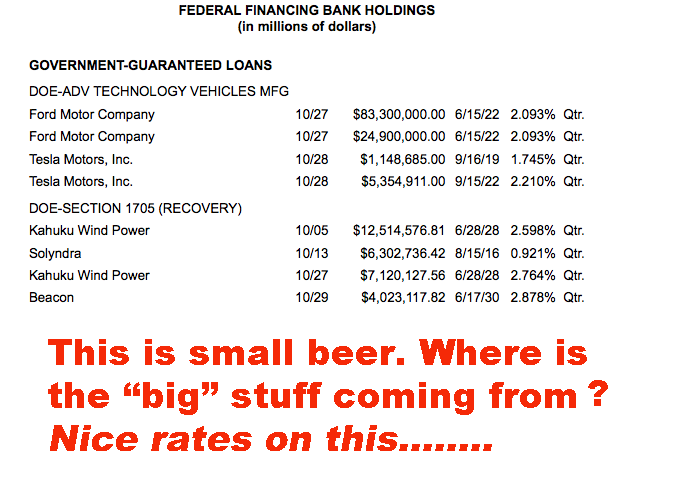
Payments of interest from the FFB to the Treasury have been less than $1 billion annually in recent years but are projected to increase (to as much as $6 billion) because of higher loan activity (particularly by the Department of Energy's Advanced Technology Vehicles Manufacturing program and the Rural Utilities Service). As of September 30, 2010, the FFB portfolio totaled $60 billion.
Hello, what is this? For interest to rise at the FFB from $1 billion to $6 billion, it would have to imply that there is at least a four- or five-fold increase in the balance sheet. This means that there is a plan to grow the FFB by $250 billion. Who is going to be the beneficiary of that? That is a hell of a lot of money. Is the FFB going to fund a solar build-out? The existing portfolio of Department of Energy loans:
Another (minor) data point of interest: The federal government has a number of trust funds that are used as accounting vehicles to store up IOUs from the government. The principal accounts and current holdings:
Social Security Trust Fund…….2.6t
Civil Service Retirement Fund...0.8t
Military Retirement Fund……...0.3t
Medicare……………………….0.3t
All others…….………………...0.6t

Total:…………………………..4.6 trillion
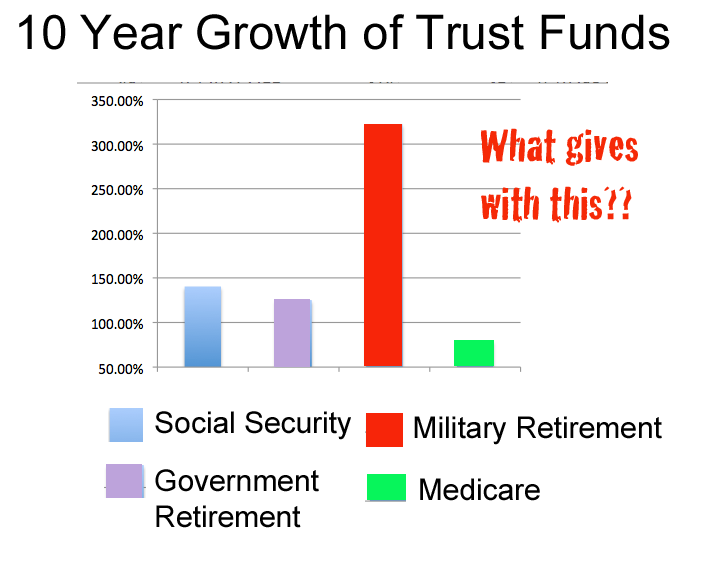
These funds are all anticipated to grow over the next decade. One has a growth rate that is way out of whack with the others:
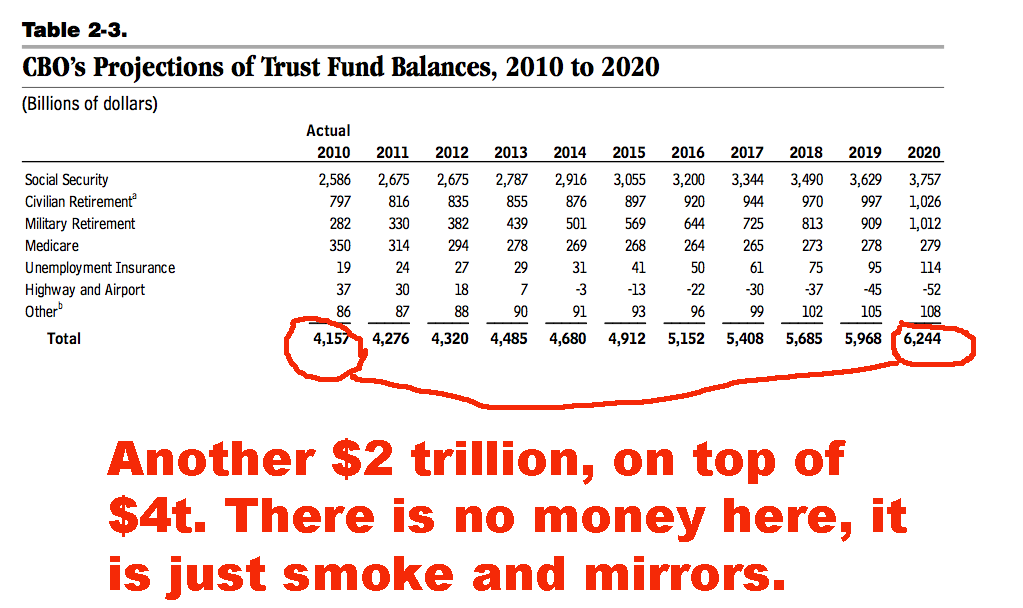
The Military Retirement Fund is growing at three times the rate of the others. The raw numbers are $282 billion for 2010 and $1.012 trillion for 2020. That's a 10-year increase of $730 billion (a 350% increase). What is that about? Are we planning on a new war, or have we just not accounted for the retirement costs of the military properly over the past decade or two? I suspect (hope) it is the latter.
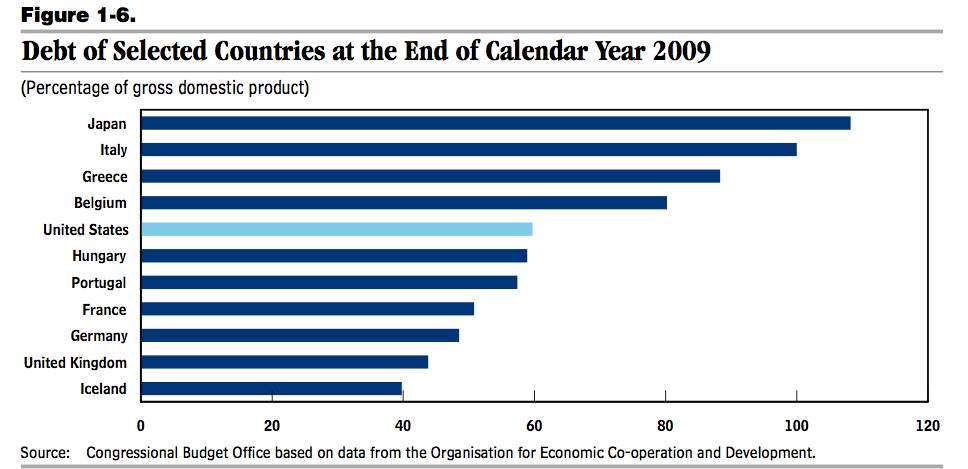
We have all seen a form of this chart elsewhere. It is nothing to be proud of. Yes, there are a few countries in worse shape than us. But Italy, Greece and Belgium are now making front-page news with their debt. And the U.S. will have a different outcome than Japan.
This chart of trust fund assets is central to our problem. Notice that these funds are scheduled to grow by more than $2 trillion. It sounds nice that the nation has trust funds where money is squirreled away someplace safe -- money that can be used to pay bills (Social Security) when they come due over the next 20 years.
But there is no money in the trust funds. They have IOUs that obligate future taxpayers to come up with the cash when needed. The trust funds have nothing to do with “savings” in the traditional sense.
This has been going on since 1983, when Greenspan created the accounting gimmick and the huge surpluses that followed. The fact is we do have future liabilities, and there have been some savings set aside for that. But the money has been spent on funding past deficits. So, really, there are no savings.
I am not sure there is a fix to this problem. I do know that the bills on this are coming due in the next five years or so. I don’t think we will make it another 10 years without having to confront this problem.


Debt Factoids on Our National Debt Are Puzzling - And Scary - Seeking Alpha

Dec 6, 2010

No, The Big Banks Have Not "Paid Back" Government Bailouts and Subsidies

No, The Big Banks Have Not "Paid Back" Government Bailouts and Subsidies

Source: zero hedge - on a long enough timeline, the survival rate for everyone drops to zero
Author: George Washington - Washington's Blog
The big banks claim that they have paid back all of the bailout money they received, and that the taxpayers have actually made money on the bailouts.
However, as Barry Ritholtz notes:
Pro Publica has been maintaining a list of bailout recipients, updating the amount lent versus what was repaid.
So far, 938 Recipients have had $607,822,512,238 dollars committed to them, with $553,918,968,267 disbursed. Of that $554b disbursed, less than half — $220,782,546,084 — has been returned.
Whenever you hear pronunciations of how much money the TARP is making, check back and look at this list. It shows the TARP is deeply underwater.
Moreover, as I pointed out in May, the big banks have received enormous windfall profits from guaranteed spreads on interest rates:
Bloomberg notes:
"The trading profits of the Street is just another way of measuring the subsidy the Fed is giving to the banks," said Christopher Whalen, managing director of Torrance, California-based Institutional Risk Analytics. "It's a transfer from savers to banks."
The trading results, which helped the banks report higher quarterly profit than analysts estimated even as unemployment stagnated at a 27-year high, came with a big assist from the Federal Reserve. The U.S. central bank helped lenders by holding short-term borrowing costs near zero, giving them a chance to profit by carrying even 10-year government notes that yielded an average of 3.70 percent last quarter.
The gap between short-term interest rates, such as what banks may pay to borrow in interbank markets or on savings accounts, and longer-term rates, known as the yield curve, has been at record levels. The difference between yields on 2- and 10-year Treasuries yesterday touched 2.71 percentage points, near the all-time high of 2.94 percentage points set Feb. 18.
Harry Blodget explains:
The latest quarterly reports from the big Wall Street banks revealed a startling fact: None of the big four banks had a single day in the quarter in which they lost money trading.
For the 63 straight trading days in Q1, in other words, Goldman Sachs (GS), JP Morgan (JPM), Bank of America (BAC), and Citigroup (C) made money trading for their own accounts.
Trading, of course, is supposed to be a risky business: You win some, you lose some. That's how traders justify their gargantuan bonuses--their jobs are so risky that they deserve to be paid millions for protecting their firms' precious capital. (Of course, the only thing that happens if traders fail to protect that capital is that taxpayers bail out the bank and the traders are paid huge "retention" bonuses to prevent them from leaving to trade somewhere else, but that's a different story).
But these days, trading isn't risky at all. In fact, it's safer than walking down the street.
Why?
 Because the US government is lending money to the big banks at near-zero interest rates. And the banks are then turning around and lending that money back to the US government at 3%-4% interest rates, making 3%+ on the spread. What's more, the banks are leveraging this trade, borrowing at least $10 for every $1 of equity capital they have, to increase the size of their bets. Which means the banks can turn relatively small amounts of equity into huge profits--by borrowing from the taxpayer and then lending back to the taxpayer.
The government's zero-interest-rate policy, in other words, is the biggest Wall Street subsidy yet. So far, it has done little to increase the supply of credit in the real economy. But it has hosed responsible people who lived within their means and are now earning next-to-nothing on their savings. It has also allowed the big Wall Street banks to print money to offset all the dumb bets that brought the financial system to the brink of collapse two years ago. And it has fattened Wall Street bonus pools to record levels again.
Paul Abrams chimes in:
To get a clear picture of what is going on here, ignore the intermediate steps (borrowing money from the fed, investing in Treasuries), as they are riskless, and it immediately becomes clear that this is merely a direct payment from the Fed to the banking executives...for nothing. No nifty new tech product has been created. No illness has been treated. No teacher has figured out how to get a third-grader to understand fractions. No singer's voice has entertained a packed stadium. No batter has hit a walk-off double. No "risk"has even been "managed", the current mantra for what big banks do that is so goddamned important that it is doing "god's work".
Nor has any credit been extended to allow the real value-producers to meet payroll, to reserve a stadium, to purchase capital equipment, to hire employees. Nothing.
Congress should put an immediate halt to this practice. Banks should have to show that the money they are borrowing from the Fed is to provide credit to businesses, or consumers, or homeowners. Not a penny should be allowed to be used to purchase Treasuries. Otherwise, the Fed window should be slammed shut on their manicured fingers.
And, stiff criminal penalties should be enacted for those banks that mislead the Fed about the destination of the money they are borrowing. Bernie Madoff needs company.
There is another type of guaranteed spread that allows the giant banks to make money hand over fist. Specifically, the Fed pays the big banks interest to borrow money at no interest and then keep money parked at the Fed itself. (The Fed is intentionally doing this for the express purpose of preventing too much money from being lent out to Main Street.)
The newly-released Fed data shows that the Fed also threw money at many of the big banks at ridiculously low interest rates.
And as I also pointed out, the government gave tax subsidies to the too big to fails:
The Treasury Department encouraged banks to use the bailout money to buy their competitors, and pushed through an amendment to the tax laws which rewards mergers in the banking industry (this has caused a lot of companies to bite off more than they can chew, destabilizing the acquiring companies).
Indeed, the Wall Street Journal noted this week:
A series of tax relief measures is saving companies bailed out by the government billions of dollars at a time when concern over tax revenues has risen.
Although the Treasury Department first provided the tax guidance in the fall of 2008, the magnitude of the tax savings has become clearer in the past year ....

"The agencies are literally throwing gratuities at banks and other companies," said Christopher Whalen, a bank stock analyst at Institutional Risk Analytics.
And as I've previously reported:
Too Big As Subsidy 
The Treasury Department encouraged banks to use the bailout money to buy their competitors, and pushed through an amendment to the tax laws which rewards mergers in the banking industry (this has caused a lot of companies to bite off more than they can chew, destabilizing the acquiring companies)
***
The fact that the giant banks are "too big to fail" encourages them to take huge, risky gambles that they would not otherwise take. If they win, they make big bucks. If they lose, they know the government will just bail them out. This is a gambling subsidy.
The very size of the too big to fails also decreases the ability of the smaller banks to compete. And - since the government itself helped make the giants even bigger - that is also a subsidy to the big boys (see this).
The monopoly power given to the big banks (technically an "oligopoly") is a subsidy in other ways as well. For example, Nobel prize winning economist Joseph Stiglitz said in
September that giants like Goldman are using their size to manipulate the market:
"The main problem that Goldman raises is a question of size: 'too big to fail.' In some markets, they have a significant fraction of trades. Why is that important? They trade both on their proprietary desk and on behalf of customers. When you do that and you have a significant fraction of all trades, you have a lot of information."

Further, he says, "That raises the potential of conflicts of interest, problems of front-running, using that inside information for your proprietary desk. And that's why the Volcker report came out and said that we need to restrict the kinds of activity that these large institutions have. If you're going to trade on behalf of others, if you're going to be a commercial bank, you can't engage in certain kinds of risk-taking behavior."
The giants (especially Goldman Sachs) have also used high-frequency program trading which not only distorted the markets - making up more than 70% of stock trades - but which also let the program trading giants take a sneak peak at what the real (aka "human") traders are buying and selling, and then trade on the insider information. See this, this, this, this and this. (This isfrontrunning, which is illegal; but it is a lot bigger than garden variety frontrunning, because the program traders are not only trading based on inside knowledge of what their own clients are doing, they are also trading based on knowledge of what all other traders are doing).
Goldman also admitted that its proprietary trading program can "manipulate the markets in unfair ways". The giant banks have also allegedly used their Counterparty Risk Management Policy Group (CRMPG) to exchange secret information and formulate coordinated mutually beneficial actions, all with the government's blessings.
In addition, the giants receive many billions in subsidies by receiving government guarantees that they are "too big to fail", ensuring that they have to pay lower interest rates to attract depositors.
Derivatives 
The government's failure to rein in derivatives or break up the giant banks also constitute enormous subsidies, as it allows the giants to make huge sums by keeping the true price points of their derivatives secret. See this and this.
Toxic Assets
The PPIP program - which was supposed to reduce the toxic assets held by banks - actually increased them, and just let the banks make a quick buck.
In addition, the government suspended mark-to-market valuation of the toxic assets held by the giant banks, and is allowing the banks to value the assets at whatever price they desire. This constitutes a huge giveaway to the big banks.
As one writer notes:
By allowing banks to legally disregard mark-to-market accounting rules, government allows banks to maintain investment grade ratings.
By maintaining investment grade ratings, banks attract institutional funds. That would be the insurance and pension funds money that is contributed by the citizen.
As institutional money pours in, the stock price is propped up ....
Mortgages and Housing
PhD economists John Hussman and Dean Baker (and fund manager and financial writer Barry Ritholtz) say that the only reason the government keeps giving billions to Fannie and Freddie is that it is really a huge, ongoing, back-door bailout of the big banks.
Many also accuse Obama's foreclosure relief programs as being backdoor bailouts for the banks. (See thisthis and this).
 
Foreign Bailouts 
The big banks - such as JP Morgan - also benefit from foreign bailouts, such as the European bailout, as they are some of the largest creditors of the bailed out countries, and the bailouts allow them to get paid in full, instead of having to write down their foreign losses.
When all of the different bailouts and subsidies given to the big banks are added up, it is obvious that they have not come anywhere close to "paying back" what we gave to them.

Read more…

Bernanke on CBS’s ‘60 Minutes’ - Real Time Economics - WSJ

Need a Real Sponsor here

Bernanke on CBS’s ‘60 Minutes’

Federal Reserve Chairman Ben Bernanke appeared Sunday evening on CBS’s “60 Minutes” to discuss the state of the economy, the central bank’s controversial $600 billion bond-buying plan and the financial crisis. Following are excerpts from the interview with CBS’s Scott Pelley, as released by the network:
Q: The major banks are racking up profits in the billions. Wall Street bonuses are climbing back up to where they were. And yet, lending to small businesses actually declined in the third quarter. Why is that?

A: A lot of small businesses are not seeking credit, because, you know, because their business is not doing well, because the economy is slow. Others are not qualifying for credit, maybe because the value of their property has gone down. But some also can’t meet the terms and conditions that banks are setting.
Q: Is this a case of banks that were eager to take risks that ruin the economy being now unwilling to take risks to support the recovery?

A: We want them to take risks, but not excessive risks. we want to go for a happy medium. And I think banks are back in the business of lending. But they have not yet come back to the level of confidence that –or overconfidence –that they had prior to the crisis. We want to have an appropriate balance.
Q: What did you see that caused you to pull the trigger on the $600 billion, at this point?

A: It has to do with two aspects. the first is unemployment The other concern I should mention is that inflation is very, very low, which you think is a good thing and normally is a good thing. But we’re getting awfully close to the range where prices would actually start falling.
Q: Falling prices lead to falling wages. It lets the steam out of the economy. And you start spiraling downward. … How great a danger is that now?

A: I would say, at this point, because the Fed is acting, I would say the risk is pretty low. But if the Fed did not act, then given how much inflation has come down since the beginning of the recession, I think it would be a more serious concern.
Q: Some people think the $600 billion is a terrible idea.
A: Well. I know some people think that but what they are doing is they’re looking at some of the risks and uncertainties with doing this policy action but what I think they’re not doing is looking at the risk of not acting.
Q: Many people believe that could be highly inflationary. That it’s a dangerous thing to try

A: Well, this fear of inflation, I think is way overstated. we’ve looked at it very, very carefully. We’ve analyzed it every which way. One myth that’s out there is that what we’re doing is printing money. We’re not printing money. The amount of currency in circulation is not changing. The money supply is not changing in any significant way. What we’re doing is lowering interest rates by buying treasury securities. And by lowering interest rates, we hope to stimulate the economy to grow faster. So, the trick is to find the appropriate moment when to begin to unwind this policy. And that’s what we’re going to do.
Q: Is keeping inflation in check less of a priority for the Federal Reserve now?

A: No, absolutely not. What we’re trying to do is achieve a balance. We’ve been very, very clear that we will not allow inflation to rise above two percent or less.
Q: Can you act quickly enough to prevent inflation from getting out of control?

A: We could raise interest rates in 15 minutes if we have to. So, there really is no problem with raising rates, tightening monetary policy, slowing the economy, reducing inflation, at the appropriate time. Now, that time is not now.
Q: You have what degree of confidence in your ability to control this?

A: One hundred percent.
Q: Do you anticipate a scenario in which you would commit to more than 600 billion?

A: Oh, it’s certainly possible. And again, it depends on the efficacy of the program. It depends, on inflation. And finally it depends on how the economy looks.
Q: How would you rate the likelihood of dipping into recession again?

A: It doesn’t seem likely that we’ll have a double dip recession. And that’s because, among other things, some of the most cyclical parts of the economy, like housing, for example, are already very weak. And they can’t get much weaker. And so another decline is relatively unlikely. Now, that being said, I think a very high unemployment rate for a protracted period of time, which makes consumers, households less confident, more worried about the future, I think that’s the primary source of risk that we might have another slowdown in the economy.
Q: You seem to be saying that the recovery that we’re experiencing now is not self-sustaining.

A: It may not be. It’s very close to the border. — it takes about two and a half percent growth just to keep unemployment stable. And that’s about what we’re getting. We’re not very far from the level where the economy is not self-sustaining.
Q: [On calls to cut the deficit]

A: We need to play close attention to the fact that we are recovering now. We don’t want to take actions this year that will affect this year’s spending and this year’s taxes in a way that will hurt the recovery. That’s important. But that doesn’t stop us from thinking now about the long term structural budget deficit. We’re looking at ten, 15, 20 years from now, a situation where almost the entire federal budget will be spent on Medicare, Medicaid, Social Security, and interest on the debt. There won’t be any money left for the military or for any other services the government provides. We can only address those issues if we think about them now.
Q: How concerned are you about the calls that you’re beginning to hear on Capitol Hill that would curb the Fed’s independence?
A: Well, the Fed’s independence is critical. The central bank needs to be able to make policy without short term political concerns. In order to do what’s best for the economy. We do all of our analysis, we do all of our policy decisions based on what we think the economy needs. Not based on when the election is or what political conditions are.
Q: Is there anything that you wish you’d done differently over these last two and a half years or so?

A: Well, I wish I’d been omniscient and seen the crisis coming, the way you asked me about, I didn’t, But it was a very, very difficult situation. And– the Federal Reserve responded very aggressively, very proactively
Q: How did the Fed miss the looming financial crisis?
A: there were large portions of the financial system that were not adequately covered by the regulatory oversight. So, for example, AIG was not overseen by the Fed. … The insurance company that required the bailout, was not overseen by the Fed. It didn’t really have any real oversight at that time. Neither did Lehman Brothers the company that failed Now, I’m not saying the Fed should not have seen some of these things. One of things that I most regret is that we weren’t strong enough in in putting in consumer protections to try to cut down on the subprime lending problem. That was an area where I think we could have done more.
Q: The gap between rich and poor in this country has never been greater. In fact, we have the biggest income disparity gap of any industrialized country in the world. And I wonder where you think that’s taking America.

A: Well, it’s a very bad development. It’s creating two societies. And it’s based very much, I think, on– on educational differences The unemployment rate we’ve been talking about. If you’re a college graduate, unemployment is five percent. If you’re a high school graduate, it’s ten percent or more. It’s a very big difference. It leads to an unequal society and a society– which doesn’t have the cohesion that– that we’d like to see.
Q: We have talked about how the next several years are going be tough years in this country. But I wonder what you think about the ten year time horizon. Fifteen years. How do things look to you long term?

A: Long term, I have a lot of confidence in the United States. We have an excellent record in terms of innovation. We have great universities that are involved in technological change and progress. We have an entrepreneurial culture, much more than almost any other country. So, I think that in the longer term the United States will retain its leading position in the world. But again, we gotta get there. And we have some very difficult challenges over the next few years.
Copyright 2008 Dow Jones & Company, Inc. All Rights Reserved
This copy is for your personal, non-commercial use only. Distribution and use of this material are governed by our Subscriber Agreement and by copyright law. For non-personal use or to order multiple copies, please contact Dow Jones Reprints at 1-800-843-0008 or visit
www.djreprints.com


Bernanke on CBS’s ‘60 Minutes’ - Real Time Economics - WSJ

Share
-- The MasterFeeds

Nov 18, 2010

GM Breaks For Trading

from zerohedge.com

GM Breaks For Trading

Links:
[1] http://www.zerohedge.com/sites/default/files/images/user5/imageroot/gono/GM.png

GM Breaks For Trading

Share
-- The MasterFeeds

Nov 16, 2010

Paulson Sept 30

Paulson Sells Large Portions Of BofA, Citi, Wells, Capital One, Dumps All Of Goldman, Adds 500,000 In Potash Merger Arb

http://www.zerohedge.com/article/paulson-sells-large-portions-bofa-citi-wells-jpm-dumps-all-goldman-adds-500000-potash-merger?utm_source=feedburner&ut


Paulson Sept 30_1.jpg (JPEG Image, 761x1675 pixels) - Scaled (30%)


Comparte esta pagina|

Oct 30, 2010

Gold Will Outlive Dollar Once Slaughter Comes: John Hathaway - Bloomberg

Gold Will Outlive Dollar Once Slaughter Comes: John Hathaway - Bloomberg

Share
________________________

Oct 29, 2010

still not ready to accept reality…

Investors realise gold is not all that glitters

By Ellen Kelleher

Published: October 29 2010 18:30 | Last updated: October 29 2010 18:30

The focus of investors scouting about for value in the precious metals market has shifted to palladium, platinum and silver, as gold now trades at record levels.

Investment flows into exchange-traded funds (ETFs) backed by platinum and palladium have about matched or exceeded those wending their way into gold-backed ETFs in the last month, data from ETF Securities shows.

The rise in the metals’ prices is just as impressive. The cost of palladium – used as a catalyst in converters that clean car exhausts – soared 93 per cent to $626 a troy ounce in the past year, hitting a nine-year high thanks to a pick-up in interest from hedge funds. Silver – the poor man’s gold – now costs $23.73 per troy ounce, having risen more than 45 per cent in the same period. And platinum – palladium’s sister metal and a requisite component in diesel car engines – trades at more than $1,680 a troy ounce.

“Much like gold and platinum, palladium has experienced a QE2 sugar rush, not looking back since its $459.25 low of August 12 after the Fed decided to hold its balance-sheet constant,” said Edel Tully, a UBS commodities strategist.

The uptick in interest in the metals stems from the uncertainty surrounding the economy as well as fears about another round of quantitative easing in the US, and concerns about currency depreciation.

But volatility remains a concern. Starting next week, precious metal prices are likely to see sharp swings because of expected announcements from the Bank of England and the Federal Reserve, analysts forecast.

“Between now and the Federal Open Market Committee day, precious metals will likely endure patience-testing and see-saw price action,” wrote Tully in a recent note.

But even if prices swing in the near-term, longer-term forecasts for palladium in particular and platinum as well look compelling.

“Of all the precious metals, we’re most bullish on palladium,” claims Walter De Wet, head of commodities research at Standard Bank in London. “Demand is also strong for platinum but not as strong as it is for palladium.”

Demand for palladium is set to continue to exceed supply in the coming years as ownership of petrol-based cars becomes commonplace in China and other emerging market countries.

At the same time, palladium’s supply looks constrained. Some analysts speculate that the Russian government’s stockpiles of palladium may have dried up. Sales from the Russian government have added about 1m ounces of palladium supply annually in recent years.

UBS’s Tully forecasts that a shortage of supply from Russia could push palladium prices above $1,000 per troy ounce. Platinum prices, meanwhile, which have been rising since late 2008, look more toppy by comparison. Analysts argue that they have been pushed higher by speculators and the flow of money into emerging markets, which tends to boost commodities demand. While some expect platinum – the only metal that can be used as a catalytic converter in diesel engines – to rise higher yet in 2011, they think a correction is likely one day given that the metal has fewer industrial uses than palladium and is more costly.

“We believe that platinum positioning is over-extended; particularly as no ‘new’ fundamental driver has emerged,” says a recent UBS commodities research report.

Prospects for silver, meanwhile, are even less clear. While the metal still trades at record levels, commodities experts claim that it tends to move in line with the gold price. They warn that history suggests silver underperforms gold when markets fall and outperforms it when they rise. “The silver market surplus is quite bloated at the moment,” points out Suki Cooper of Barclays Capital. “If investment demand slows down for silver, we’re likely to see a sharp correction.”

But “silver fever” is still all the rage, with sales of silver coins set to hit a record high this year. Standard Bank’s De Wet concludes that gold and silver prices – which continue to benefit from strong interest from Asia – will see support through the Chinese new year which begins in February.

Copyright The Financial Times Limited 2010. Print a single copy of this article for personal use. Contact us if you wish to print more to distribute to others.

"FT" and "Financial Times" are trademarks of the Financial Times. Privacy policy | Terms
© Copyright The Financial Times Ltd 2010.

http://www.ft.com/cms/s/2/18ef998a-e382-11df-8ad3-00144feabdc0.html

Oct 5, 2010

Insider Selling To Buying: 2,341 To 1 | zero hedge

Insider Selling To Buying: 2,341 To 1


Insider Selling To Buying: 2,341 To 1 | zero hedge

Share
-- The MasterFeeds

Oct 3, 2010

On Tomorrow's Secret Meeting To Plot The End Of High Frequency Trading | zero hedge

On Tomorrow's Secret Meeting To Plot The End Of High Frequency Trading


On Tomorrow's Secret Meeting To Plot The End Of High Frequency Trading | zero hedge


Sep 26, 2010

Supply Squeeze of Physical Gold and Silver May Be Heating Up | Coin Update News


Within the past 48 hours, as gold and silver have broken to new highs (ignoring inflation), there are some indications that demand for physical precious metals may be on the rise.

Supply Squeeze of Physical Gold and Silver May Be Heating Up

My company does not deal with the customers who make purchases of tens to hundreds of millions of dollars at a time. Such buyers normally deal direct with the major brokers in London or New York. Instead, our median purchaser of gold and silver bullion-priced products probably spends less than $5,000 per transaction. We do have a number of customers who regularly spend five or six figures and the occasional seven figure deal, but my company’s total volume is unimportant when compared to total global precious metals trading.
Still, we are in constant communication with several primary distributors of products for the US Mint and other world mints that issue bullion products. We also keep in touch with a number of other wholesalers across the country. If there is a change in product availability or price level, we learn about it quickly.
Today my company enjoyed one of its five highest retail sales days of the past 30 years. As we were contacting wholesalers to replenish our inventories, we picked up what may be significant indicators that a supply squeeze of physical gold and silver could be heating up.
Three different wholesalers who are primary distributors for the US Mint told us that they have experienced a sharp increase in demand for physical silver coins and ingots in the past 48 hours.
When we tried to purchase a quantity of South Africa 1 Ounce Gold Krugerrands, we were also in for a shock. Yesterday, these coins were available pretty much everywhere, with wholesalers competing to sharpen their pencils to shave their ask price. Today, two of the wholesalers were completely out of Krugerrands for live delivery. Our cost to purchase these coins increased almost 0.5% more above the gold value than they did just the day before!
One more indicator of a potential supply squeeze is the “spot” price quoted by wholesalers. For protection in volatile markets, wholesalers often use two different spot prices, depending on whether they are buying or selling. For our last large silver order today, the distributor used an ask silver spot price that was eight cents higher than its bid spot price. Previously this company had used the same spot price for both buying and selling or had a maximum spread of just four cents for silver.
Our suddenly zooming retail demand and reports that this may be happening across the country, if it continues for a few more days, could spark another buying frenzy such as we experienced in late 2008. Two years ago, availability was so tight that it was not unusual for customers to have to wait at least a month after making payment to receive their merchandise. In 2008, premiums soared for just about any live physical gold and silver. At the peak, bags of US 90% Silver Coins were selling retail for about 40% above their intrinsic metal value!
Along with my expectations of higher gold and silver prices, I have also predicted that supplies of physical metals would dry up. This may be now occurring. However, we cannot be sure until we see the pattern continue for another couple of days. Should this pattern continue through next Tuesday afternoon, I would recommend not waiting any longer to establish your position in precious metals. To be extra safe, you may now want to wait even that long.


Supply Squeeze of Physical Gold and Silver May Be Heating Up | Coin Update News

_______________________________________

Sep 14, 2010

Market Still Deluding Itself That It Can Escape The Inevitable Dénouement

 Until we face up to the reality of the economic landscape before us, we will be on the same path as Japan, 1987-present...


Market Still Deluding Itself That It Can Escape The Inevitable Denouement 
By Albert Edwards, Société Générale, London
 
The current situation reminds me of mid 2007. Investors then were content to stick their heads into very deep sand and ignore the fact that The Great Unwind had clearly begun. But in August and September 2007, even though the wheels were clearly falling off the global economy, the S&P still managed to rally 15%! The recent reaction to data suggests the market is in a similar deluded state of mind. Yet again, equity investors refuse to accept they are now locked in a Vulcan death grip and are about to fall unconscious.
The notion that the equity market predicts anything has always struck me as ludicrous. In the 25 years I have been following the markets it seems clear to me that the equity market reacts to events rather than pre-empting them. We know from the Japanese Ice Age and indeed from the US 1930's experience, that in a post-bubble world the equity market merely follows the economic cycle. So to steal a march on the market, one should follow the leading indicators closely. These are variously pointing either to a hard landing or, at best, a decisive slowdown. In my view we are poised to slide back into another global recession: the data is slowing sharply but, just like Japan in its Ice Age, most still touchingly believe we are soft-landing. But before driving off a cliff to a hard (crash?) landing we might feel reassured when we pass a sign that reads Soft Landingand we can kid ourselves all is well.
I read an interesting article recently noting the equity market typically does not begin to slump until just AFTER analysts begin to cut their 12m forward EPS estimates (for the life of me I can't remember where I read this, otherwise I would reference it). We have not quite reached this point. But with margins so high, any cyclical slowdown will crush productivity growth. Already in Q2, US productivity growth fell 1.8% - the steepest fall since Q3 2006.Hence, inevitably, unit labour costs have begun to rise QoQ. This trend will be exacerbated by recent more buoyant average hourly earnings seen in the last employment report. Whole economy profits are set for a 2007-like squeeze. And a sharp slide in analysts' optimism confirms we are right on the cusp of falling forward earnings (see chart below).
OTBImage01
I love the delusion of the markets at this point in the cycle. It bemuses me why investors cannot see what is clear as the rather large nose on my face. Last Friday saw the equity market rally as August's 67k rise in private payrolls and an upwardly revised July rise of 107kbeat expectations. But did I miss something? When did we switch from looking at headline payrolls to private jobs? Does the fact that government is shedding jobs not matter? Admittedly temporary census workers do mess up the data, but hey, why not look at nonfarm payroll data ex census? Why not indeed? Because the last 4 months run of data looks notably weaker on payrolls ex census basis than looking only at the private payroll data (ie Aug 60k vs 67k, July 89k vs 107k, June 50k vs 61k and May 21k vs 51k). But these data, on either definition, look dreadful compared to the 265k rise in April and 160k in March (ex census definition). If someone as pathologically lazy as me can find the relevant BLS webpage after a quick call to the BLS (link), why can't the market? Because it is bad news, that's why.
OTBImage02
August's rebound in the US manufacturing ISM was an even bigger surprise. This is a truly nonsensical piece of datum as it was totally at variance with the regional ISMs that come out in the weeks before. The ISM is made up of leading, coincident and lagging indicators. The leading indicators - new orders, unfilled orders and vender deliveries - all fell and point to further severe weakness in the headline measure ahead (see chart above). It was the coincident and lagging indicators such as production, inventories and employment that drove up the headline number. Some of the regional subcomponents (eg Philadelphia Fed workweek) are SCREAMING that recession is imminent (see left hand chart below).
OTBImage03 OTBImage04
The real reason why markets reversed last week was that they got ahead of themselves. Aside from the end of 2008, government bonds were the most over-bought they had been over the last decade. And in equity-land the AAII two weeks ago recorded a historically low 20% of respondents as bullish (see chart above). These technical extremes will now be quickly worked off before the plunge in equity prices and bond yields resumes.
I am often asked by investors with a similar view of the world to my own (yes, there are some),whether the equity market will ever reach my 450 S&P target because of the likelihood that further Quantitative Easing will prevent asset prices from falling back to cheap levels.
Indeed we know that a central plank of the unhinged policies being pursued by the Fed and other central banks is to use QE to deliberately target higher asset prices. Ben Bernanke in a recent Jackson Hole speech dressed this up as a "portfolio balance channel", but in reality we know from current and previous Fed Governors (most notably Alan Greenspan), that they view boosting equity and property prices as essential for boosting economic activity. Same old Fed with the same old ruinous policies. And by keeping equity and property prices higher, the US and UK Central Banks are still trying to cover up their contribution towards the ruination of American and British middle classes - (see GSW 21 January 2010, Theft! Were the US and UK central banks complicit in robbing the middle classes? - link).
The Fed may indeed prevent equity prices from slumping with any QE2 announcement. But this sounds a familiar refrain at this point in the cycle. For is monetary easing in the form of QE that different from interest rate cuts in its ability to boost equity prices? Indeed announced rate cuts in previous downturns often did generate decent technical rallies. But in the absence of any imminent cyclical recovery, equity prices continue to slide lower (see chart below). The key for me is whether QE2 can revive the economic cycle, not equity prices temporarily.
OTBImage05
In the absence of a cyclical recovery I cannot see how QE is any different in its ability to revive asset prices than lower rates in anything other than a temporary fashion. (Interestingly many of our clients think QE2 might give a temporary fillip to the risk assets but that the subsequent failure to produce any cyclical impact will cause an extremely violent reaction as investors lose faith in QE as a policy tool and Central Banks in general.)
If we plunge back into recession, do not place too much confidence in the Central Banks having control of events. As my colleague, Dylan Grice, said last week "let them keep pressing their buttons." Ultimately they cannot fool all of the investors, all of the time.

ShareThis


The MasterFeeds

MasterSearch

Categories

MasterFeeds News Finance china USA money stocks debt Venezuela Commodities Gold United States Dollars bonds Banks trading Markets economics FED Hedge funds Israel Oil Asia LatAm default credit metals Mining international relations russia central_banks democracy elections CapitalMarkets HFT zerohedge Euro Japan Silver India Iran Middle East SEC bailout Africa Europe Liberalism Trade UN bitcoin insider trading Agriculture FX Tech Trump VC copper corruption real estate Brazil CoronaVirus ForEx Gold Silver Hamas Maduro NYSE WeWork chavez food goldman government Abu Dhabi Arabs EU Facebook France IPO NASDAQ Palestinians SWF TARP Turkey canada ponzi recession revolution war Anti-Israel Cannabis Capitalism Citigroup Democrats EIA Hezbollah Jobs Lebanon NYC PDVSA Saudi Arabia Softbank Stats Syria Ukraine demographics socialism 13F AIG Advertising Berkshire Hathaway CBO Cargill Colombia Cryptocurrency ETF Ecuador Emerging Markets Eton Park Google Housing IMF JPM LME Mindich Mongolia OPEC PIIGS Pakistan Palantir Paulson Pensions Peru Politics Potash QE Scams Singapore Spain UK Yuan blockchain companies crash cybersecurity data freedom humor islam kleptocracy nuclear propaganda social networks startups terrorism Airlines Andorra Angola Apple Automobiles BAC BHP Blackstone COMEX Caracas Coal Communism Crypto DRC DSK Double-Dip EOS Egypt FT Fannie Mae Form Foxconn Freddie GM Gbagbo History ICO Iraq Italy Ivanhoe Ivory Coast Juan Guaido Lava Jato Libya London M+A MasterEnergy Mc Donald's Miami Mugabe Norway Norwegian Odebrecht Oyo PA PPT Panama QE2 Republicans Rio Ron Paul ShengNu Soleimani South Africa Tokens Tunisia UN Watch UNESCO UNHRC Uber VW Wyclef anti-semitism apparel bang dae-ho cash censorship chile clothing coffee cotton derivatives emplyment foreclosures frontrunning haiti infrastructure labor levi's mortgages philosophy shipping social media treasury women