MasterFeeds

Subscribe in a reader Add to Google Reader or Homepage

Oct 15, 2012

The Future of America Is Japan: Runaway #Deficits, Runaway #Debts | ZeroHedge

If-when- interest rates rise in all these seriously indebted countries, things are really going to get ugly!  This from Zerohedge.com:
 
The Future of America Is Japan: Runaway Deficits, Runaway Debts | ZeroHedge
 
Submitted by Charles Hugh-Smith of OfTwoMinds blog,
If you want a look at the fiscal future of the U.S., look west to Japan, a nation that sits precariously on a fiscal cliff a thousand feet high.

If you want to know how the Keynesian Cargo Cult's grand experiment in borrowing money to fund bloated fiefdoms, rapacious cartels and bridges to nowhere ends, just look west (from California) to Japan. The Japanese State, partly because they seem to believe in the Cargo Cult, and partly to avoid exposing the insolvency of their crony-capitalist financial sector, has been borrowing and spending money on a vast scale for two decades.
The Keynesian Cargo Cult's primary article of faith is that borrowing and blowing huge sums of money on anything and everything will magically restore "aggregate demand," i.e. the animal spirits that drive people to borrow and blow money on consumption. This is of course pure insanity, as people cannot borrow if their balance sheet has been destroyed, their real incomes are declining and they have lost trust in institutions that fear transparency and the truth like the Devil fears garlic.
Recall that the Federal Reserve's Survey of Consumer Finances for 2007-2010 found that the median net worth of households fell a staggering 39%, from $126,400 to $77,300, and average household income fell 11% from $88,300 to $78,500.
But rather than face the fraud and corruption at the heart of American (and Japanese) finance and governance, the Keynesians just want to leave the predatory, parasitic crony-capitalist Status Quo intact and create an illusory world of bogus "demand" and grotesque malinvestment funded by ever-increasing debt. In effect, the entire Keynesian Project seeks to reinflate asset and government revenue bubbles--the very causes of the global financial meltdown.
Let's see how the Keynesian protection of a corrupt, parastic Status Quo and pursuit of monumental malinvestment has worked for Japan. Here is the Ministry of Finance's Highlights of the Budget for FY2012 (via Andrew P.). Consider the ramifications of these numbers:
REVENUES: 90,334 (billion yen)
Tax revenues: 42,346
Other revenues: 3,744

Government Bond Issues (borrowing): 44,244
EXPENDITURES: 90,334
National Debt Service (interest): 21,944
Social Security: 26,390
Other: 42,000
So interest on the debt and Social Security are 114% of tax revenues. Put another way, tax revenues don't even cover interest on the runaway debt and Social Security costs.
An amazing 49% of the governments budget is borrowed money. Even with near-zero yields on Japanese government bonds (less than 1%), 52% of tax revenues are spent on national debt interest.
Recall that the interest rate Japan's government is paying on its stupendous debt is about 1%. Were that to double to a mere 2%, all of the new debt would go just to pay the interest on existing debt.
This is truly the Red Queen's Race. (Losing the Red Queen's Race - February 17, 2010) And it's been going on a long, long time. Japan's budget/borrowing imbalance was already severe a decade ago when I wrote this: Japan's Runaway Debt Train (2001).
Since 2005, annual borrowing has increased 10,000 billion yen (BY) while expenditures rose by 8,000 BY. Tax revenues have been stagnant at 44,000 BY while the interest expense has risen 19% and Social Security costs have increased by 29%.


You see what's happening: tax revenues are unchanged from seven years ago while interest and Social Security costs increase dramatically as the debt inexorably expands and more retirees qualify for Social Security.
Now take a look at the 2012 United States federal budget. Net interest on the $16 trillion national debt is "only" $242 billion, while Social Security costs totaled $778 billion. So far, debt and Social Security ($1 trillion) are "only" 40% of total tax revenues, but like Japan, rapidly rising debt will increase interest while a rapidly increasing population of retirees qualifying for Social Security will drive those costs dramatically higher in the years ahead.
Given $2.47 trillion in total tax revenues, $3.8 trillion in expenditures and a deficit of $1.3 trillion, 34% of the Federal budget is borrowed money. We are borrowing 52% of total tax revenues.
Does anyone seriously think this is the "road to recovery"? If you want a look at the fiscal future of the U.S., look west to Japan, a nation that sits precariously on a fiscal cliff a thousand feet high.

Guest Post: The Future of America Is Japan: Runaway Deficits, Runaway Debts | ZeroHedge

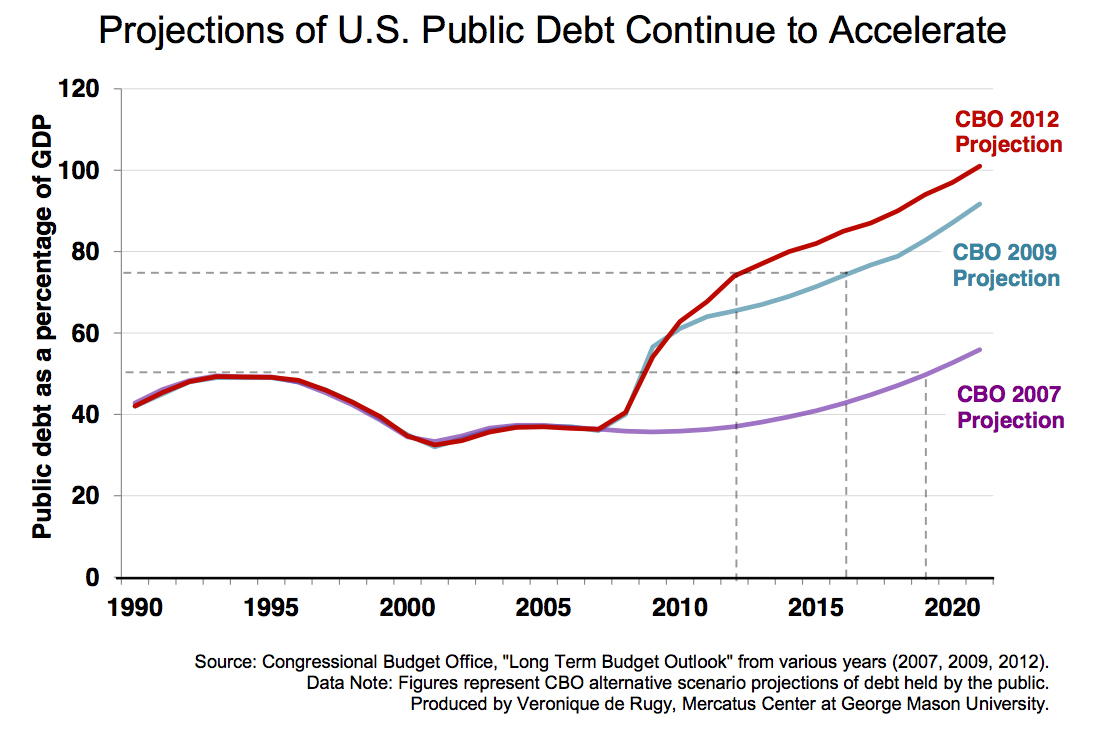
Projections of #US. Public #Debt Continue to Accelerate | Mercatus

In 2007, the CBO projected that public debt would equal up to half of total U.S. economic output by 2019. In reality, public debt-to-GDP passed this milestone in 2009—ten years ahead of the CBO’s 2007 projection

Projections of U.S. Public Debt Continue to Accelerate

Veronique de Rugy | Oct 08, 2012
This chart compares Congressional Budget Office (CBO) long-term projections of the debt held by the public as a percentage of GDP, or the debt-to-GDP ratio. Public debt comprises over two-thirds of gross national debt, and is owed to individuals, businesses, and foreign and state/local governments.

In the five years between the long-term projections calculated in 2012 and 2007, public debt milestones have moved up by nearly a decade on several occasions. In 2007, the CBO projected that public debt would equal up to half of total U.S. economic output by 2019. In reality, public debt-to-GDP passed this milestone in 2009—ten years ahead of the CBO’s 2007 projection. Importantly, the long-term projections used in this chart come from the CBO’s alternative scenario, which incorporates policy changes that were likely at the time. Hence, this is a more realistic projection than the CBO’s baseline scenario. 
Using the same methodology, CBO currently projects that debt will reach 80 percent of GDP by 2014, which is five years ahead of the 2009 projection, and thirteen years ahead of the 2007 projection.
This means that the U.S. is slipping down an unsustainable fiscal path at a much faster rate than before. This unforeseen acceleration in the public debt is important because high levels of debt can have a negative impact on the economy. Economists Carmen Reinhart and Ken Rogoff have shown that when a country’s level of debt reaches 90 percent of GDP, its economy could start shrinking by 1 percentage point every year. The U.S reached this milestone four years ago. One percentage point may not seem like a lot, but as Mercatus Senior Research Fellow Matthew Mitchell has shown, if the U.S. had reached this point in 1975, our standard of living could be 30 percent lower than it is today.

Data notes: The figures in this chart represent CBO alternative scenario projections that are meant to reflect likely changes and extensions of policies at the time of projection. The chart shows public debt, which is a portion of gross national debt. The Reinhart and Rogoff piece alludes specifically to gross national debt exceeding 90 percent of GDP.


Projections of U.S. Public Debt Continue to Accelerate | Mercatus

The MasterMetals Blog

Oct 11, 2012

Wall Street’s Forgotten Victims Have Some Advice - Bloomberg

Some advice from the 12 year old kids of the hedge fund managers in Greenwich, CT via Michael Lewis 

Wall Street’s Forgotten Victims Have Some Advice

I didn’t go looking for the kid. He found me. Of course, it stood to reason, with what’s been happening on Wall Street, that the children of Greenwich, Connecticut, must be taking a serious financial hit.
The end of cash bonuses, the ramping up of financial regulation, the shrinking of the Goldman Sachs analyst pool, Chelsea Clinton’s confessing that she quit her Wall Street job to find meaning in life: Wherever you turn, you find signs that an era in which a lot of children were paid to keep quiet is grinding to an end.
Enlarge imageMichel Lewis                                                                                              
Maybe the game is over; maybe it isn’t. But one thing is certain: If you are 12 years old, and your dad works on Wall Street, it’s a lot less likely Beyonce will be singing at your 13th birthday party.
At any rate the 12-year-old child who texted me out of the blue simply wanted to pass along a few tips. I’m not sure if he was doing it out of the goodness of his heart, or testing the market for a book deal. But he says that he knows a lot of other kids just like him, who have at least one parent who used to make a lot of money trading bonds on Wall Street, and now, instead, were being handed a lot of illiquid bank stock of dubious value.
For kids traumatized by the Wall Street downturn, he had the following advice:
-- For starters, you need to make a point of actually meeting your dad -- or your mom, but most likely it is your dad who is the problem.
He’s the one who controls the money flows but up till now he’s been a total ghost. Out the door at 5:30 in the morning, home at 11 at night. And no matter how tired he is on weekends, your mother always makes him take her out to parties, so when you do catch a glimpse of him he’s hung over and distant. You will need to take the initiative here. Set your alarm early, or, even better, stay up late. Park yourself at the front door and when your dad walks through it, stick out your hand and introduce yourself. He needs to know who he’s dealing with.
-- Accept that you are the real victim in all this.
The moaning and groaning your dad has been doing about his bonuses won’t actually change his lifestyle. He isn’t the owner of the first lost piece of the family collateralized-debt obligation: You are. Everything from summer sailing camp in the Bahamas to the smoking-hot Scandinavian nanny is probably now on a list of possible cutbacks. As totally unfair as these cuts are (you aren’t the one who lost all the money), you shouldn’t fight them. You don’t want to come across as “spoiled.” If you complain too loudly, your dad might use it as an excuse to rationalize his failure. He will start saying things to your mom like, “It may actually do him some good not to have everything he wants.” The smart first reaction is to accept that you will be making some pretty horrible sacrifices. Pretend you don’t feel a thing. Even though, inside, it’s killing you.
-- Study the way your dad’s mind works.
If you are at least 12, it’s easy to tell yourself he’s kind of dumb. I mean, even back when he was making a lot of money he didn’t notice very much about life around the house. But -- trust me -- he is really smart, especially about money. It’s just that he isn’t like other dads. He thinks emotions are stupid, for example, because emotions cost him money when he’s trading. He spends his day trying not to feel anything, so he sort of gets used to it.
Up until now he could afford to do this. Whenever he didn’t feel something he was supposed to feel, he just bought his way out of trouble. That’s why you scored the sailing camp in the Bahamas in the first place. Now it’s different. He still doesn’t feel what he is supposed to feel, but he can’t afford to buy his way out of trouble. You can exploit this. But first you need to turn up the heat on him, by creating lots of situations where he is supposed to feel something. The easiest emotion to make him feel he should be feeling is guilt. To that end...
-- Make lots and lots of new demands on his time.
Kids who don’t play the tuba or something should consider joining a travelling sports team or acting in a school play or, really, anything that requires your dad to be there to watch you do it. In theory, your dad should have more time for this kind of stuff. He isn’t making as much per hour, so his hours should be cheaper. But he doesn’t think that way. He’s trying to “get back to even.” He’s still trying to make as much as he did three years ago, which means working even more. This is tricky because you don’t want to discourage him from doing it. At the same time, his longer hours are just a huge opportunity for you. Because no matter what instrument or sport you decide to play, there is just no way he’s going to show up to watch you play it.
Like I said, he won’t tell you that he feels bad he missed your performance as the mule in “Fiddler on the Roof.” He might not know it himself. But when you see that look on his face -- it’s like he just remembered he left his credit card at the restaurant -- that’s when you strike. Make the ask. Which brings me to...
-- Always ask big.
Your dad may be smart about money but he has no idea about size. When he makes money, he doesn’t make thousands, he makes millions. When he loses it, he doesn’t lose millions, he loses billions. His scale is totally off; keep it that way. For example, you just finished your first traveling lacrosse game that your dad didn’t see, and you want a couple of little things (a new flat-screen TV for your suite, or an ATV) and one big thing -- say, to go one-on-one against LeBron James on your private court. Obviously, ask for LeBron first. If you feel you have to ask for the small stuff, too, find some way to bundle it into a single big package -- say, after he’s just forgotten your birthday.
These are hard times for Wall Street kids. It might never again pay you what you need to be paid to do the job. Down the road, if this bonus drought is more than just a temporary blip, you might need to consider quitting. Breaking up with your dad isn’t as hard as it seems. You can’t just do it yourself but your mom can -- and it isn’t like she doesn’t also have a lot of needs that suddenly aren’t being met. Encourage her to get to know some private-equity guys. If you are really ambitious, introduce her to one of those Facebook (FB) dudes who have so much money they have already retired. Your mom can figure it out. After all, you shouldn’t have to do all the work.
(Michael Lewis, most recently author of the best-selling “Boomerang: Travels in the New Third World” is a columnist for Bloomberg News. The opinions expressed are his own.)
Read the article online here: Wall Street’s Forgotten Victims Have Some Advice - Bloomberg

ShareThis


The MasterFeeds

MasterSearch

Categories

MasterFeeds News Finance china USA money stocks debt Venezuela Commodities Gold United States Dollars bonds Banks trading Markets economics FED Hedge funds Israel Oil Asia LatAm default credit metals Mining international relations russia central_banks democracy elections CapitalMarkets HFT zerohedge Euro Japan Silver India Iran Middle East SEC bailout Africa Europe Liberalism Trade UN bitcoin insider trading Agriculture FX Tech Trump VC copper corruption real estate Brazil CoronaVirus ForEx Gold Silver Hamas Maduro NYSE WeWork chavez food goldman government Abu Dhabi Arabs EU Facebook France IPO NASDAQ Palestinians SWF TARP Turkey canada ponzi recession revolution war Anti-Israel Cannabis Capitalism Citigroup Democrats EIA Hezbollah Jobs Lebanon NYC PDVSA Saudi Arabia Softbank Stats Syria Ukraine demographics socialism 13F AIG Advertising Berkshire Hathaway CBO Cargill Colombia Cryptocurrency ETF Ecuador Emerging Markets Eton Park Google Housing IMF JPM LME Mindich Mongolia OPEC PIIGS Pakistan Palantir Paulson Pensions Peru Politics Potash QE Scams Singapore Spain UK Yuan blockchain companies crash cybersecurity data freedom humor islam kleptocracy nuclear propaganda social networks startups terrorism Airlines Andorra Angola Apple Automobiles BAC BHP Blackstone COMEX Caracas Coal Communism Crypto DRC DSK Double-Dip EOS Egypt FT Fannie Mae Form Foxconn Freddie GM Gbagbo History ICO Iraq Italy Ivanhoe Ivory Coast Juan Guaido Lava Jato Libya London M+A MasterEnergy Mc Donald's Miami Mugabe Norway Norwegian Odebrecht Oyo PA PPT Panama QE2 Republicans Rio Ron Paul ShengNu Soleimani South Africa Tokens Tunisia UN Watch UNESCO UNHRC Uber VW Wyclef anti-semitism apparel bang dae-ho cash censorship chile clothing coffee cotton derivatives emplyment foreclosures frontrunning haiti infrastructure labor levi's mortgages philosophy shipping social media treasury women